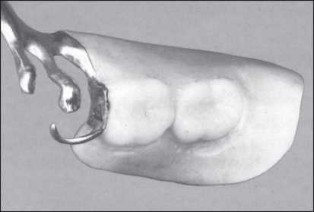
Circumferential clasps
The basic form of a circumferential clasp, which can be fabricated either by casting from Co-Cr alloy or bending the wrought wire, consists of a retentive arm that approaches the retentive undercut from the occlusal direction on the buccal surface, a reciprocal arm located on the opposite surface of the tooth, and an occlusal rest.
The circumferential clasp is the most commonly used clasp type in tooth-supported removable partial dentures due to its favorable retentive and stabilizing characteristics. However, it is generally avoided in distal extension cases, as vertical displacement of the denture base under occlusal loading may exert a torque on the terminal abutment tooth—particularly when the residual alveolar ridge is severely resorbed and covered by resilient mucosa.
Disadvantages of the circumferential clasp:
- As it approaches the undercut from the occlusal direction, it covers more tooth surface than a bar clasp.
- On certain tooth surfaces—particularly the buccal surfaces of mandibular teeth and the palatal surfaces of maxillary teeth—this approach increases the apparent occlusal width and reduces gingival stimulation.
- In the mandible, it results in greater metal visibility compared to a bar clasp.
- As with all cast clasps, its half-round shape prevents vertical adjustment for modifying retention. Effective activation requires repositioning the terminal end either occlusally toward a shallower undercut or cervically. Simply moving the clasp closer to or away from the tooth alters only frictional contact and does not influence its retentive potential. Therefore, retention is generally non-adjustable in most of the cast clasps.
Simple circumferential clasp
The simple circumferential clasp (Akers clasp) is the most frequently used clasp type and is indicated in tooth-supported dentures where a favorable retentive undercut is present. It approaches the undercut area on the abutment tooth from the edentulous space. Although the buccal arm is generally used for retention, a lingual retentive arm may also be utilized when a more favorable undercut is present on the lingual surface. When the lingual arm serves as the retentive component, the buccal arm should be positioned above the survey line and designed with rigidity to function as the reciprocal element. (Figure 3-13).
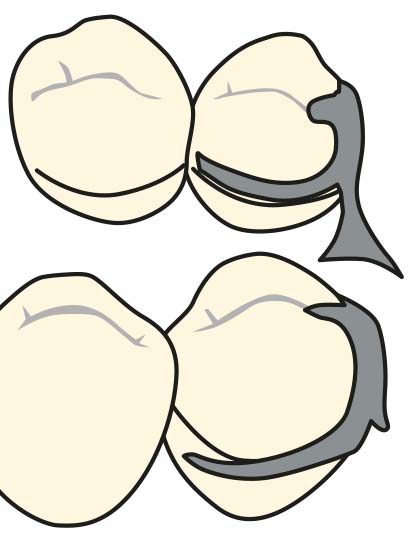
Reverse approach clasp
The reverse approach clasp (reverse Akers clasp) is used on mandibular premolars where the retentive undercut is located on the distobuccal surface adjacent to the edentulous space. The clasp shoulder originates from the mesial aspect of the abutment tooth and terminates in the retentive area on the distobuccal surface (Figure 3-14).
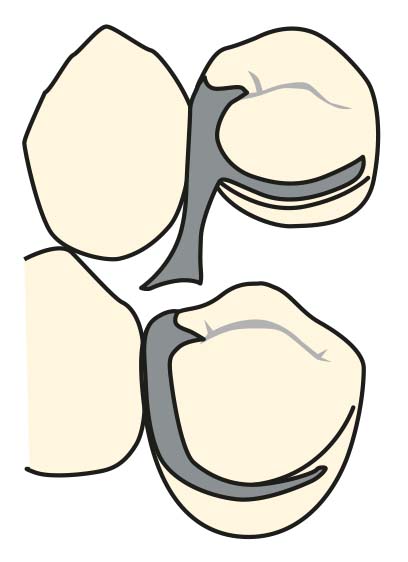
The reverse Akers clasp is beneficial in situations where a bar clasp is not suitable due to soft tissue interference on the buccal surface of the abutment tooth. One advantage of this clasp is that the force exerted by the occlusal rest in the mesial fossa is balanced by the adjacent tooth on the mesial aspect of the abutment tooth. Additionally, the stress transmitted to the abutment tooth by this clasp is lower than that of a simple circumferential clasp, particularly in Kennedy Class I and II cases. This is because when the denture base moves towards the mucosa, the retentive arm of the clasp easily moves away from the undercut area toward the gingiva, preventing torque on the abutment tooth. When the denture base rotates and moves away from the mucosa due to adhesive foods, the retentive arm engages the undercut, stabilizing the base. Due to this stabilizing feature, the reverse Akers clasp enhances the effectiveness of indirect retainers. It is more comfortable to use when a complete denture is the antagonist to a distal extension partial denture, as the necessary interocclusal distance for the occlusal rest and shoulder does not pose a problem. The disadvantage of this clasp is that it does not protect the gingival mucosa distally as effectively as the simple circumferential clasp. Additionally, because it rises between two teeth, it may create a wedging effect, which can be mitigated by adding an additional occlusal rest on the adjacent tooth. Due to its position on the mesial surface of the abutment tooth, it can pose aesthetic concerns, making it unsuitable for use in the maxillary premolar region. It should not be used when the mutual occlusal contacts are excessively close.
Ring clasp
The ring clasp is a form of circumferential clasp that covers almost the entire surface of the tooth from its point of origin (Figure 3-15).
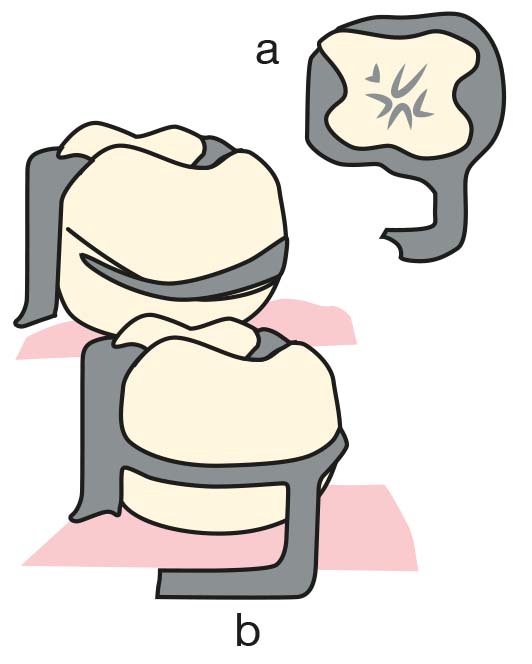
a) The ring clasp covers almost the entire tooth surface starting from its point of origin. b) The clasp originates from the mesiolingual surface and terminates at the mesio-buccal undercut, with an additional minor connector supporting the clasp.
The ring clasp is primarily used on mandibular molars, where the retentive undercut is located on the mesiolingual surface, and in less common cases, on tilted maxillary molars with a mesiobuccal undercut. When used on maxillary molars, the clasp originates on the mesiobuccal surface
and encircles the tooth to engage the mesiolingual undercut. The ring clasp should not be used without an auxiliary minor connector, as the length of the clasp prevents it from exhibiting a reciprocal function or providing horizontal stabilization without this rigid component. It is not used in the buccal region near mandibular molars if there is a soft tissue undercut or when the attachment of the buccinator muscle is close to the crown of the abutment tooth.
The ring clasp includes two occlusal rests located in the mesial and distal fossae. The function of the auxiliary occlusal rest is to balance the tipping force exerted on the abutment tooth by the rest placed mesially with the distal rest.
A modification of the ring clasp, known as the back-action clasp, approaches the undercut area like a simple circumferential clasp but has its minor connector on the palatal surface (Figure 3-16a).
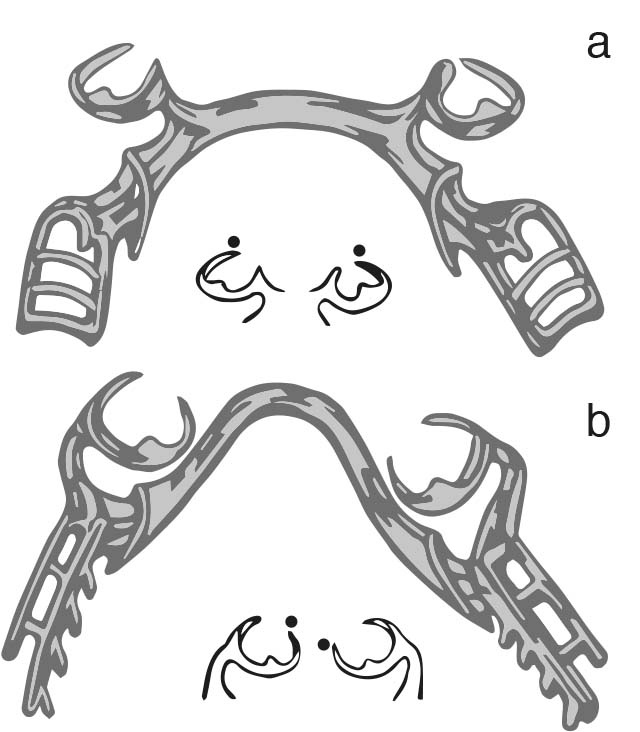
a) Back-action clasp: Uses the mesiobuccal undercut.
b) Reverse back-action clasp: Uses the mesiolingual undercut.
The back-action clasp is intended for use on teeth that are inclined buccally or have minimal undercut. However, since the proximal surface of the tooth cannot serve as a guiding plane, it is difficult to achieve the rigid support required by the occlusal rest. Although the length of the clasp arm suggests that it could function as a stress breaker on abutment teeth in distal extension cases, its lack of proper support makes it prone to distortion. As a result, it may transmit excessive buccal forces to the abutment tooth during mastication. Therefore, except for maxillary premolars inclined toward the vestibule, the use of this clasp is generally not recommended. The variation of the back-action clasp with its minor connector on the buccal surface is referred to as the reverse back-action clasp. This clasp is used on premolar teeth that are severely tilted lingually, where the retentive arm is located on the lingual surface and terminates in the mesiolingual undercut (Figure 3-16b).
Hairpin clasp
The hairpin (reverse-action) clasp is preferred for mandibular molars with mesial tilting, where the undercut is located beneath the point of origin of the clasp. It can also be used on mandibular premolars when reverse approach or bar clasps are contraindicated for any reason. However, the clinical crown length of the abutment tooth must allow for a clasp arm twice its own length. Alternative options to this clasp include the ring clasp or a bar clasp approaching the same undercut area from the gingival direction. When properly designed, the reverse-action clasp curves like a hairpin to engage the undercut located below its point of origin (Figure 3-17).
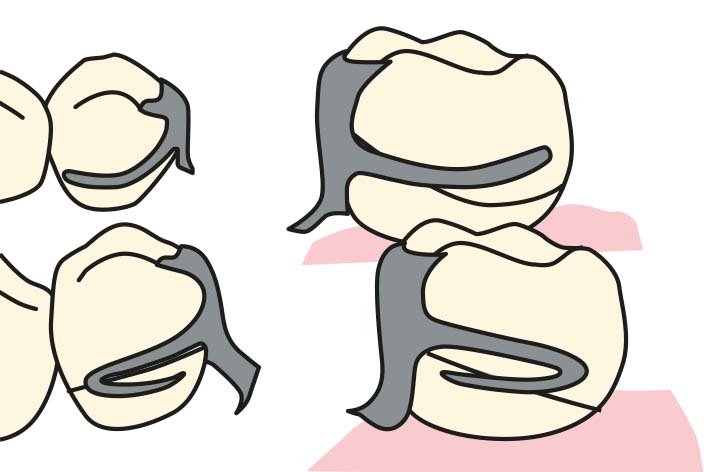
The upper arm of this clasp should be regarded as a minor connector that gradually transitions into the tapered lower arm; therefore, only the lower arm should be flexible.
The hairpin clasp is aesthetically unfavorable and should be limited to areas not visible from the anterior region of the mouth.
Embrasure clasp
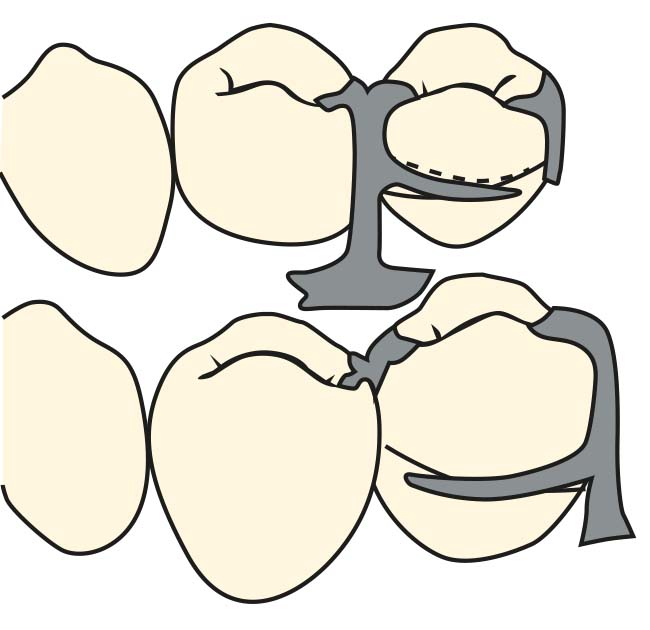
The embrasure clasp is essentially formed by joining the bodies of two simple circumferential clasps; it is also known as a double Akers clasp or back-to-back clasp (Figure 3-18).
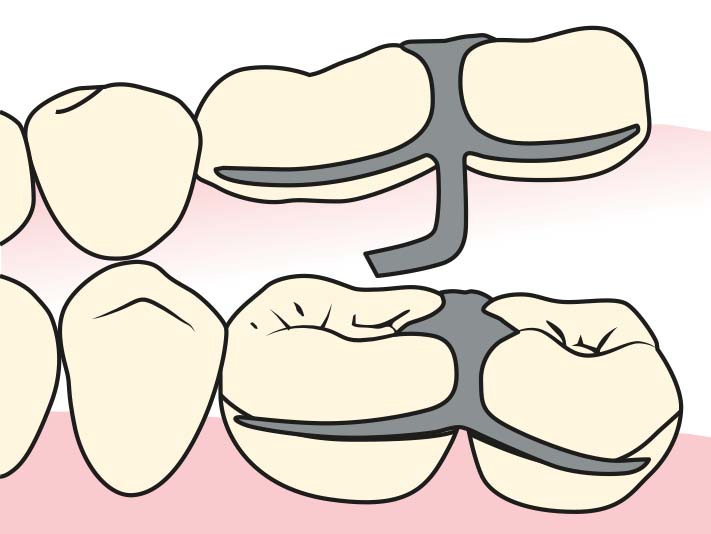
In Kennedy Class II or Class III removable partial dentures without modifications, the absence of an additional edentulous space on the opposite side of the arch to assist clasping presents a mechanical disadvantage. However, if the teeth are sound and have suitable undercuts, or if these teeth require restorations, clasping can be achieved using an embrasure clasp.
To accommodate the bodies of the embrasure clasp, sufficient space must be created between the abutment teeth at the occlusal third, though the contact area should not be completely eliminated. If adequate space is not provided with mouth preparation, the clasp may interfere with the opposing occlusion and create a wedging effect on the abutment teeth.
When planning an embrasure clasp, even if excellent proximal guiding planes are prepared, the use of double occlusal rests is essential. Without them, the abutment teeth may drift apart, leading to food impaction and clasp displacement. In addition to supporting the prosthesis, occlusal rests help prevent food accumulation in the contact area.
Multiple clasp
The multiple clasp consists of two simple circumferential clasps whose reciprocal arms are joined at their terminal ends (Figure 3-19).
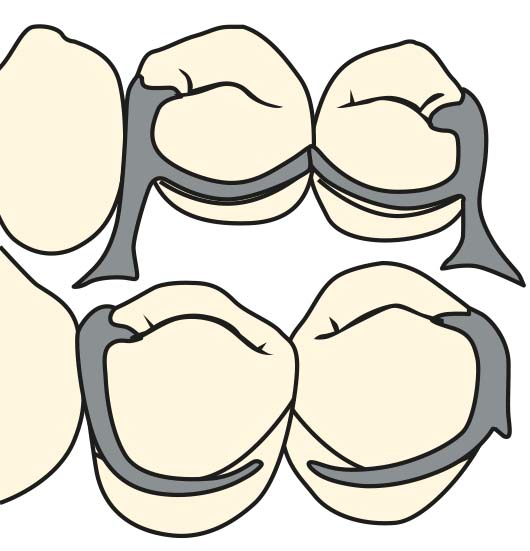
It is generally used in tooth-supported removable partial dentures when additional retention is required. It may be preferred when the prosthesis is intended to restore half of the dental arch and multiple clasps are needed, or when the terminal abutment tooth has lost periodontal support and retention must be distributed among several adjacent abutment teeth. When the undercut areas on two adjacent abutment teeth are located close to each other, a multiple clasp may be preferred over an embrasure clasp. Its disadvantage is that it requires two embrasure minor connectors instead of one.
Half- and-half clasp
Half- and-half clasp has two circumferential retentive arms rising from opposite sides of the abutment tooth. Since the second arm originates from a second minor connector, it usually takes the form of a circumferential clasp, with or without an auxiliary occlusal rest (Figure 3-20).
Reciprocation is achieved with a short bar or an auxiliary occlusal rest, preventing the covering of too much tooth surface. Therefore, the use of the half-and-half clasp is not recommended in bilateral distal extension cases. The design of this clasp generally follows the principle of creating two-directional retention, which is applicable in unilateral distal extension cases.
RPA clasp
The RPA clasp consists of a rest, a proximal plate, and a circumferential clasp retentive arm extending from this plate to the mesiobuccal undercut area. The shoulder portion of the clasp arm contacts the height of contour at the junction of the middle and gingival thirds of the tooth. This clasp system is preferred in all distal extension removable partial dentures because it provides mesial support with mesio-occlusal rest. Its excellent encirclement feature is achieved through the minor connector supporting the rest, the proximal plate contacting the tooth surface facing the edentulous space, and the shoulder of the clasp arm (Figure 3-21).