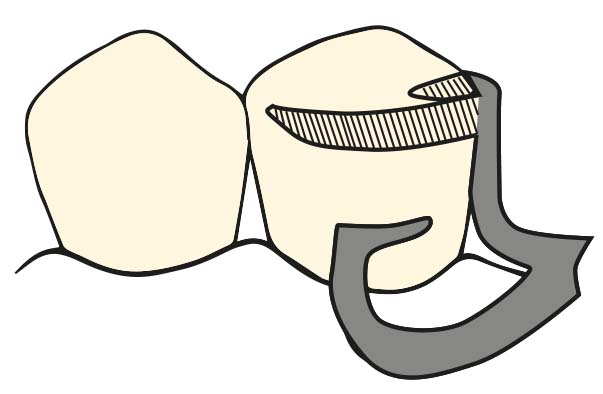
Combination clasps
Wrought-wire combination clasp
This clasp system consists of a distal rest, a cast circumferential reciprocal arm, and a full round wire retentive clasp arm. The major connector plate can also be used in place of a reciprocal arm. The retentive arm is normally in the form of a circumferential clasp, but it can alternatively be formed as a bar clasp starting from the gingival direction of the denture base. The drawback of distal occlusal rest planning is eliminated by the retentive arm’s flexibility.
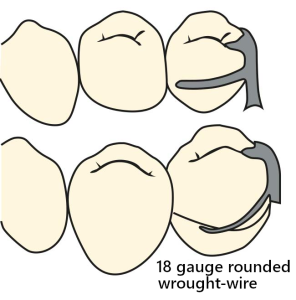
The wrough-wire circumferential clasp arm can be fused with cas clasp components using laser welding, while the wrough-wire clasp made in the form of a bar clasp can be embedded into the acrylic denture base.
The advantages of the combination clasp are flexibility, adaptability, and the aesthetic appearance of the wrough-wire clasp arm. It is used when the use of a bar clasp is not suitable on a tooth adjacent to a distal extension or on a weak abutment tooth from a periodontal support, to provide maximum flexibility. This is because the wrough-wire wire clasp bends in all planes, absorbs torque forces, and provides a more appropriate force distribution on the abutment tooth. When precise retention is required or when the retention of the clasp needs to be increased or decreased later, it is preferred due to its ability to adapt easily because of its round cross-section. Since the cross-section of the wrough-wire clasp is round, it attracts less attention compared to the limited surface form of the cast clasp.
The most common situations for using the combination clasp are when there is only a mesiobuccal undercut on the abutment tooth adjacent to a distal extension, and when there is a soft tissue undercut preventing the use of a bar clasp, along with periodontally weak abutments.
In this case, the distal rest is preferred because, as the beginning part of the clasp arm is located above the height of contour, during functional movements, it moves the mesial rest away from the tooth.
This clasp design is also recommended when the abutment tooth is tilted mesially. The combination clasp can also be used in Kennedy Class II cases with a posterior modification, on the secondary abutment tooth anterior to the modification space. A distal extension rotating towards the tissue around a diagonal fulcrum axis can be caused by the torsional effect of the secondary abutment in the palatal direction. One way to reduce this torque is to use a more flexible retentive clasp arm on the secondary abutment in addition to the terminal abutment. When the distance between the secondary abutment tooth and the most posterior abutment tooth in the arch does not allow for the length of the bar clasp arm, the combination clasp becomes the only option.
Bar and circumferential combination clasp
It is a combination clasp that has a stabilizing arm constructed of circumferential clasp features and a retentive arm that is a bar clasp. It is a combination clasp that has a stabilizing arm constructed of circumferential clasp features and a retentive arm that is a bar clasp. When the abutment tooth’s retentive area is located next to the edentulous area, it is ideal. The weak reciprocation in bar clasps is strengthened by using the circumferential resiprocation arm. The same criteria that restrict the usage of bar clasps also apply to this particular clasp (Figure 3-28).