
Chapter 4. Indirect Retainers
The component of a distal extension removable partial denture that resists movement of the denture base away from the tissue around the primary fulcrum line is called an indirect retainer.
When a distal extension prosthesis is subjected to occlusal load, the fulcrum line (Primary Stabilizing Fulcrum: PSF) passes through the rests of the abutment teeth. The rotational movement of the denture base toward the residual ridge, caused by masticatory forces around this fulcrum line, is limited by the remaing supporting ridge or ridges (Figure 4-1).
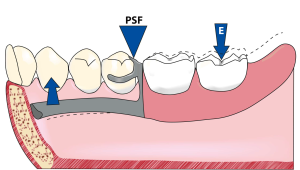
The rotational movement of the denture base away from the ridge, caused by the effects of sticky foods, forces exerted by adjacent tissues during speech, mastication, and swallowing, as well as gravitational forces acting on the maxilla, can be prevented through the use of indirect retainers. When the denture base moves away from the tissue, the fulcrum line shifts from the rests to the retentive arms of the clasps (Retentive Fulcrum: RF). As a result, the anterior portion of the prosthesis, such as the lingual bar, moves downward, potentially causing trauma to the underlying tissues (Figure 4-2a).
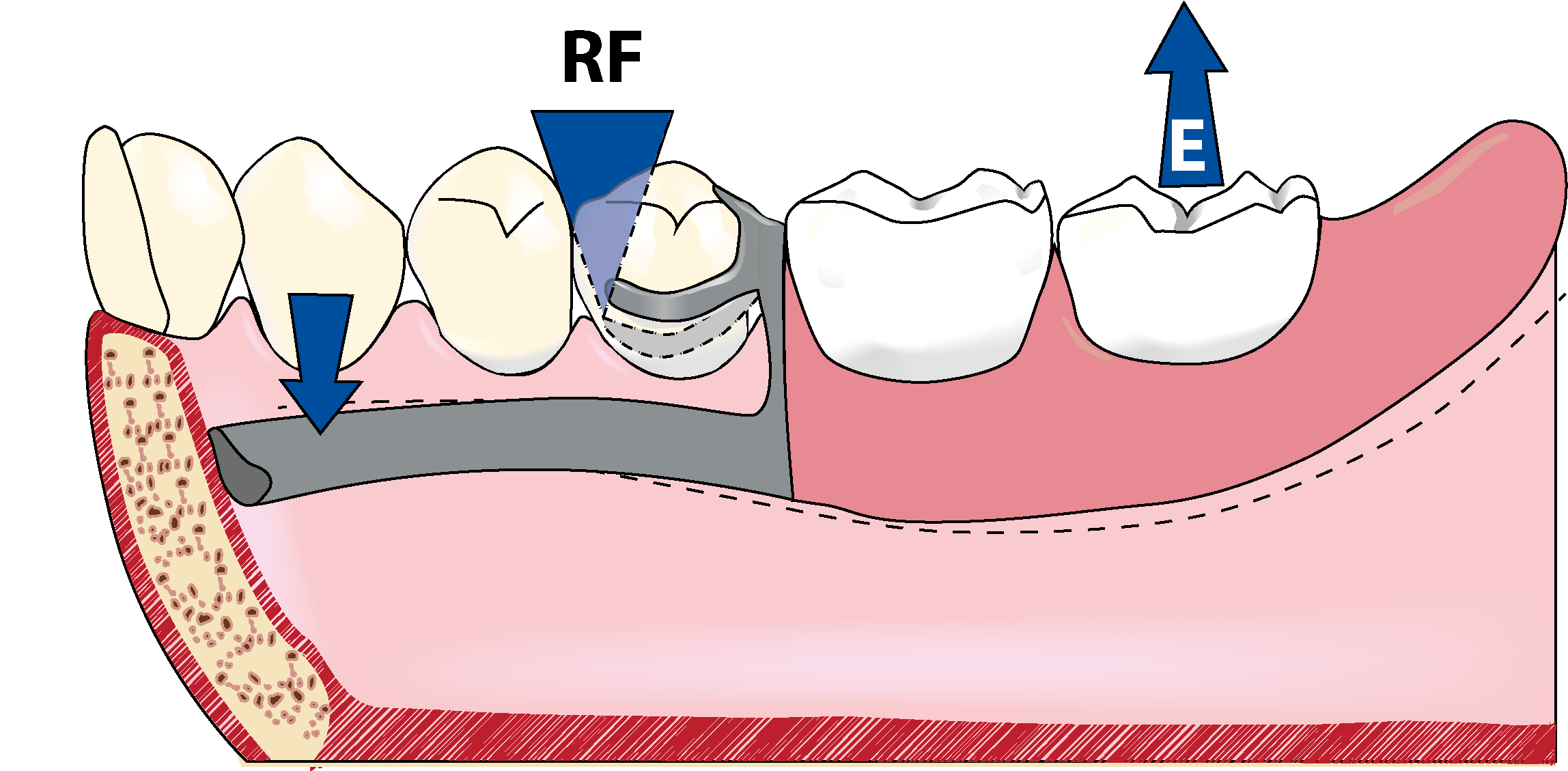
The rest that functions as an indirect retainer, placed anterior to the RF, resists the movement of the prosthesis away from the tissue by creating a counterforce along a lever arm equal to the distance between the point of force application (E) and the RF. In the presence of an indirect retainer, the fulcrum line passes through the indirect retainer placed on the secondary abutment (Secondary Stabilizing Fulcrum: SSF) (Figure 4-2b).

To balance the rotation of the denture base, the indirect retainer should be placed as far from the fulcrum line as possible. Due to factors such as the inclined lingual surfaces of the anterior teeth, aesthetic concerns, and the length of the distal extension denture base, rests used as indirect retainers cannot typically be placed as far from the fulcrum as the lever arm distance. In a prosthesis with an indirect retainer, a class II lever is now involved.
In removable partial dentures supported entirely by natural teeth, the direct retainers on the abutment teeth resist the tendency of the prosthesis to dislodge or rotate. These types of partial dentures may only require an indirect retainer due to cross-arch stabilization.
Indirect retainers, in addition to controlling the rotational movements of the denture base, also serve several auxiliary functions:
- By providing additional support, they distribute the masticatory forces across a greater number of teeth.
- When placed on a single solitary abutment tooth, the indirect retainer can help minimize the tipping effect caused by leverage in the anterior-posterior direction. In fact, this situation should be avoided as much as possible, because the proximal contact between the abutment tooth and its adjacent teeth prevents tipping of the abutment tooth during the movement of the denture base away from the tissue.
- When occlusal functional forces are applied to the prosthesis, they provide additional support by preventing the major connector from sinking into the supporting tissues.
- The contact of the minor connector of the indirect retainer with the axial surfaces of the teeth helps stabilize the prosthesis against horizontal forces.
- The anterior group of teeth supporting the indirect retainer are splinted against movement in the lingual direction.
- During the rebasing/relining or functional impression procedures for the distal extension denture base, they serve as a third reference point for the framework, ensuring proper positioning of the prosthesis on the abutment teeth.
Several factors must be considered to enhance the effectiveness of an indirect retainer:
- Effectiveness of direct retainers: For the indirect retainer to function properly, the direct retainer must resist the displacement of the denture base and the movement of the principle rests away from the primary abutment tooth and supporting tissues. If the retentive arms of the clasps fail to fulfill this function, the indirect retainer cannot prevent rotational movement around the fulcrum lines or the overall displacement of the prosthesis.
- Distance from the fulcrum line: The greater the distance between the fulcrum line and the indirect retainer, the more effective the indirect retainer becomes.
- Rigidity of the connector supporting the indirect retainer: The minor connector supporting the indirect retainer must be rigid to ensure that its effect is not diminished in any part of the prosthesis.
- Effectiveness of the supporting tooth surface: The indirect retainer should be placed on definite rest seats that can offer resistance to stress; it should not be placed on inclined tooth surfaces.
Forms of indirect retainers
The indirect retainer may take any one of several forms. All are effective in proportion to their support and distance from the fulcrum line.
- Auxiliary occlusal rest
- Canine rests
- Canine extensions from occlusal rests
- Cingulum bars (continuous bars) and linguoplate
- Modification areas
- Rugae support