
Planes and axes
Movement in the human body occurs in three planes: horizontal, sagittal and frontal.
These planes intersect each other at right angles. The intersection of any two planes creates a linear axis; these are called horizontal, vertical and sagittal axes (Figure 1-3).
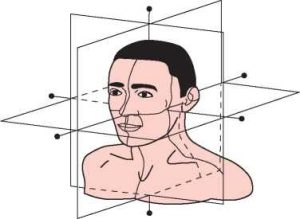 |
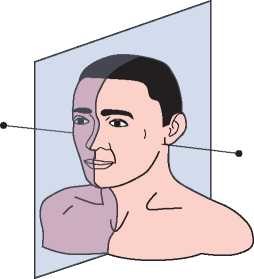 |
| Three planes and three axes | Sagittal plane-horizontal axis |
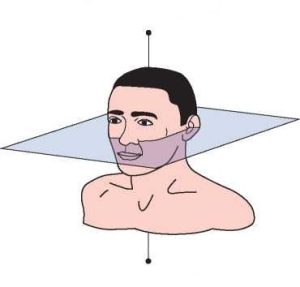 |
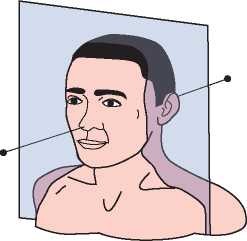 |
| Horizontal plane-vertical axis | Frontal plane-sagittal axis |
The rotational movement of a body around any of the three axes occurs within the plane perpendicular to the respective axis. These three planes and axes are utilized to describe the movements of RPDs. Understanding the functional movements of RPDs resulting from applied forces is essential for planning prosthetic components that can effectively minimize or control such movements. The successful planning of RPDs requires a comprehensive understanding of both mechanical principles and biological considerations.
Tooth- and tissue-supported (free-end) prostheses derive support from two distinct tissues—teeth and the residual ridge covered by mucosa—which differ in resiliency. This dual support results in a wide range of forces and movements, potentially generating more harmful stresses on the supporting structures. Distal-extension prostheses tend to rotate around an imaginary axis referred to as the fulcrum line or fulcrum axis.
Fulcrum axes (lines) can be classified and named in three distinct ways:
1. Based on the planes,
2. Based on the structural elements of the prosthesis,
3. Based on the position and number of abutment teeth in the arch.
In the following section, we will first examine fulcrum axes according to planes.