
Surveying the master cast
The master cast should be examined as a new cast after the mouth preparation, but the previously established guide planes help to precisely position the cast in the anteroposterior direction.
The lateral tilt of the cast corresponds to the position that provides equal retentive areas on all primary abutment teeth, in relation to the planned clasp design. When deciding to create equal retentive areas on the abutment teeth, considerations should be given to situations that increase flexibility on primary abutments for distal extension cases. When clasps required for the primary abutment teeth have equal length, diameter, shape, and material, the degree of undercut is equalized; otherwise, changes necessitated by the case should be reflected in the cast tilt.
During mouth preparation, excessive interferences will have been eliminated. After determining the path of placement for guide planes and balanced retention, the remaining minor interference areas are corrected by blockout procedures.
If the mouth preparation does not achieve the desired outcome, a new impression is taken after repeating the preparation or the cast tilt is slightly adjusted to accommodate the path of placement.
The blockout procedure includes not only the areas through which only the rigid parts of the prosthesis will pass during insertion and removal, but also:
- Areas necessary for patient comfort,
- Edges where the clasps will be placed,
- Relief areas under the connectors to prevent tissue injury, and
- Relief zones created for the subsequent connection of the denture base to the metal framework.
Blockout materials consist of a mixture of wax and clay; rigid inlay waxes can also be used for this purpose. To facilitate the carving process after waxing, the surveyor blade can be lightly heated.
Paralleled blockout must be performed on the cervical surfaces of the guide planes as well as on all surveyed areas through which the major and minor connectors will pass.
Other surveyed areas that are necessary for patient comfort or to facilitate duplication can be blocked out using modeling wax. These areas include labial surfaces and labial undercuts not involved in the prosthesis design, as well as sublingual and distolingual areas outside the prosthesis borders. Since these areas are unrelated to the path of placement, their blockout does not require the use of the dental surveyor.
Shaped blockout is applied to the buccal and lingual surfaces to allow the placement of wax or plastic patterns for clasp appoach arms.
Paralleled blockout is applied to the following areas:
- Proximal tooth surfaces used as guide planes,
- Undersurfaces of minor connectors,
- Undercut areas through which rigid connectors will pass,
- Undercut areas where the terminal portions of bar clasp arms will pass,
- Deep interproximal spaces that will be covered by minor connectors or a lingual plate,
- Undersurfaces of bar clasp arms corresponding to the gingival margin.
Arbitrary blockout is applied to the following areas:
- All gingival margins,
- Deep tissue undercuts starting beneath the areas designated for the metal framework,
- Tissue undercuts located distal to the metal framework,
- Labial and buccal tooth and tissue undercuts that are not included in the prosthesis design.
It is essential to clearly distinguish between blockout and relief procedures. The relief procedure refers to the reduction of pressure in areas where tissue trauma is to be avoided during placement or use of the prosthesis, following blockout. For example, after blocking out the tissue undercuts that would interfere with the placement of a lingual bar, these areas are scraped parallel to the path of placement. However, this step alone does not constitute a relief intended to prevent tissue injury.
Depending on the position of the connector, the inclination of the alveolar ridge, and the degree of prosthesis rotation, additional relief of varying thickness may be necessary along with blockout. In cases where the lingual alveolar ridge inclines downward and posteriorly, the application of force to the posterior part of the prosthesis may not cause discomfort in the lingual area. In such cases, proper polishing of the underside of the lingual bar can prevent soft tissue injury (Figure 7-15).
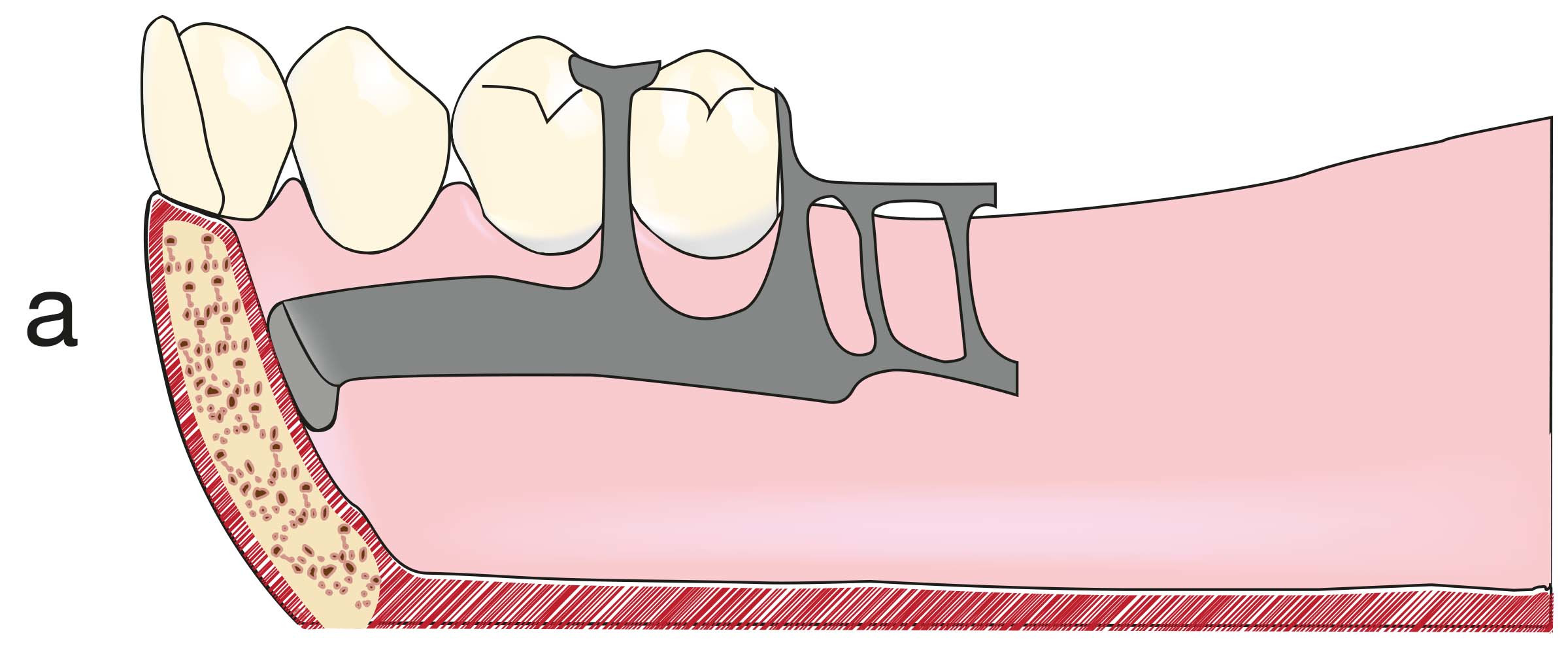
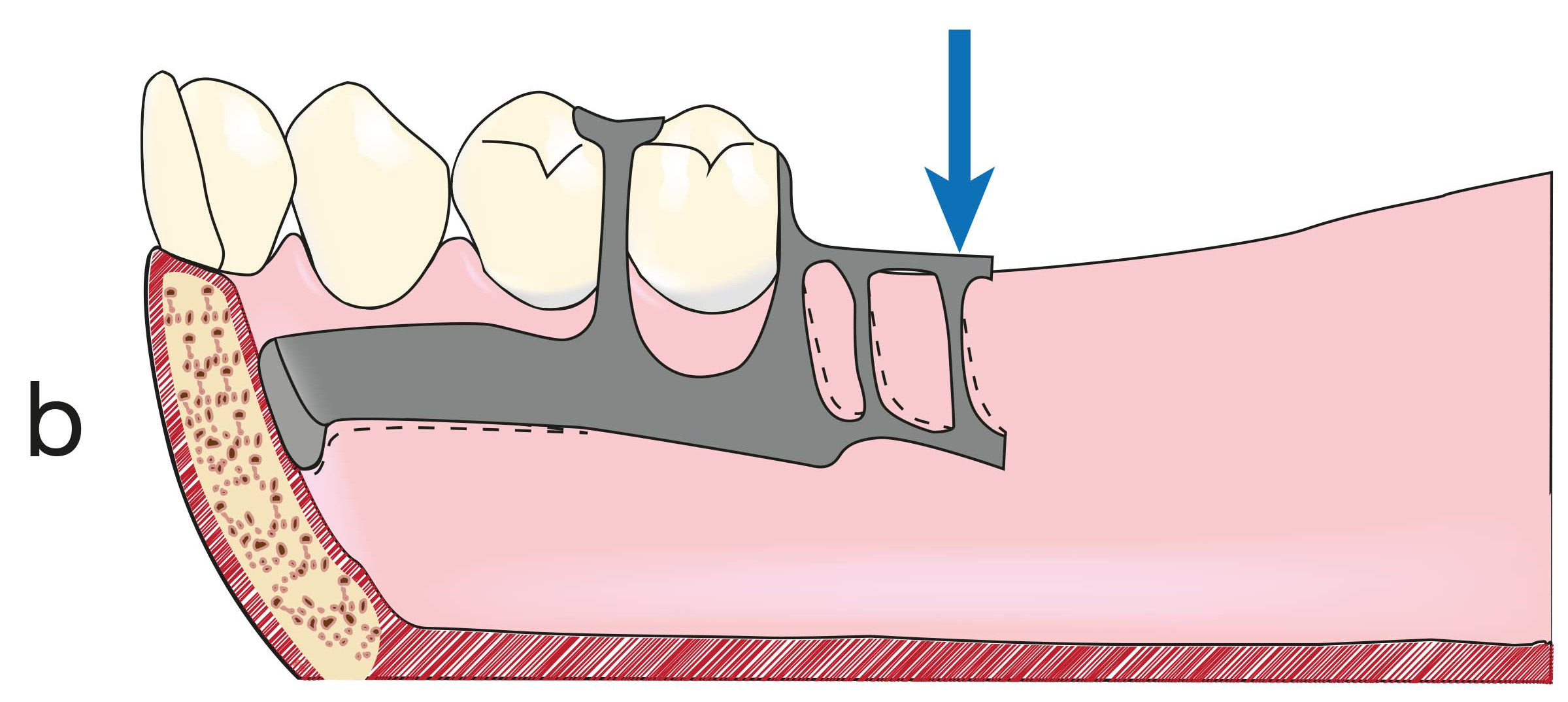
During the fabrication stages of the prosthesis, relief is also applied to provide space for the subsequent prosthetic material.
Areas where relief is applied include:
- Beneath lingual bars or bar portions of lingual plates in regions where the gingival margin needs to be exposed,
- The undersurface of major connectors that will contact thin mucosa over firm areas, such as the lingual side of the mandibular ridge or excessively prominent palatal median raphe,
- Beneath framework extensions (minor connectors) onto ridge areas located over the ridge, which provide retention for acrylic resin bases.