
Determining the indirect retainers

The distal extension denture base should be stabilized by indirect retainers that prevent its displacement away from the tissues around the fulcrum line.

When planning indirect retainers, the retentive fulcrum line passing through the direct retainers is first identified, and a perpendicular line is drawn to this axis. The indirect retainers are rests placed on this perpendicular line at the farthest possible distance from the fulcrum line. These rests are seated in specially prepared rest seats to ensure that the transmitted forces are directed along the long axis of the tooth.

In order to engage multiple teeth, major connectors such as a lingual plate or a Kennedy bar may also be used.

Cl I prostheses

The ideal location for indirect retainers, based on the fulcrum line, is the two central incisors. However, this is not feasible due to the inclined lingual surfaces of the mandibular incisors. Although an incisal rest can technically be placed between the central incisors, it is generally not suitable because it causes patient discomfort and poses esthetic concerns (Figure 8-32).
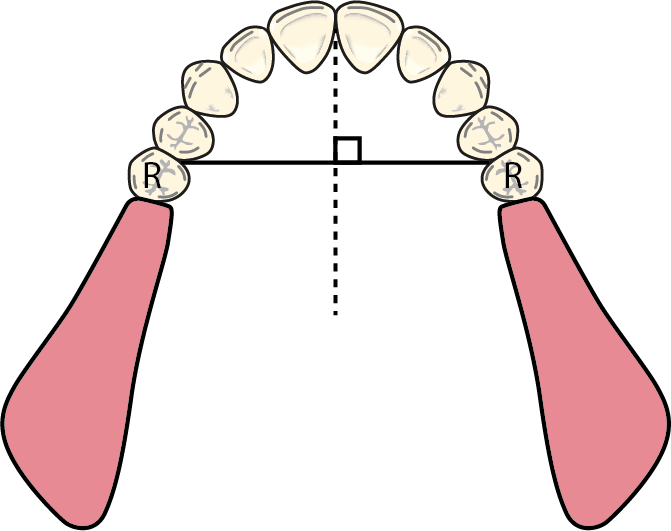
 

Figure 8-32. Indirect retainer positioning in a Class I design. (R): Retainer.
Figure 8-32. Indirect retainer positioning in a Kennedy Class I design. (R): Retainer.

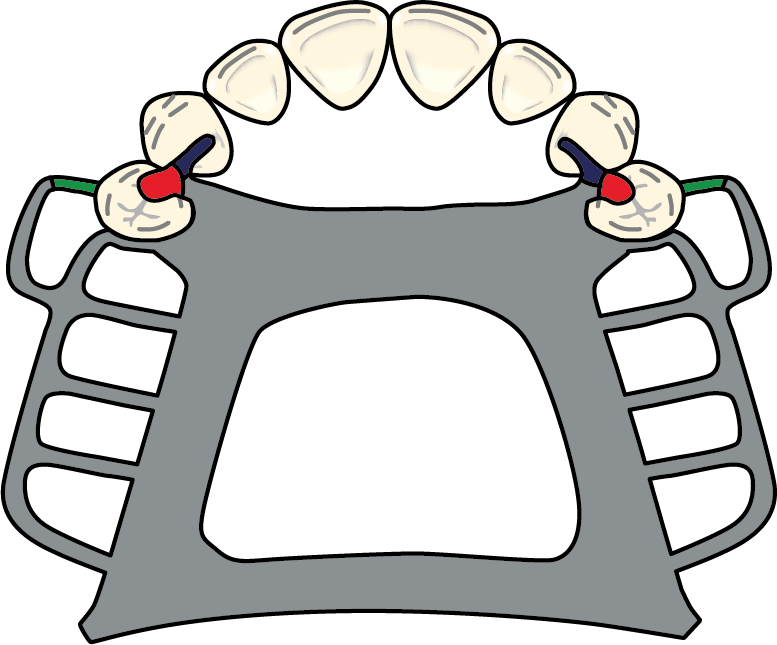
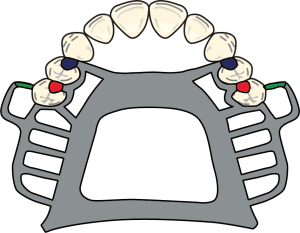
In this case, the most appropriate option for the indirect retainer is an auxiliary occlusal rest on the mesial of the right and left premolars and a canine extension (Figure 8-33).
a
b
Figure 8-33. In Cl I prostheses, the most ideal indirect retainers are the canine extension (a) and the auxiliary occlusal rest (b).

When a modification space is present in the anterior region, a cingulum rest shoul not be used on the anterior teeth because of nonfavorable stress factors according to inclined plane principle (Figure 8-34). A U-shaped plate having rugae support can be an alternative indirect retainer together with cingulum rests placed on canines.
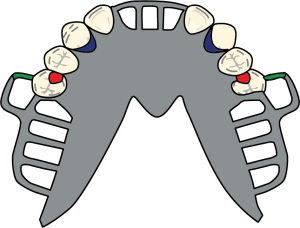
 

Figure 8-34. In Class I prostheses, when an anterior modification is present, a cingulum rest cannot be used as an indirect retainer on anterior teeth due to the inclined plane principle. A U-shaped plate providing rugae support, combined with cingulum rests on the canines, serves as the most ideal indirect retainer.

Cl II prostheses

Rests placed in the region where the primary fulcrum line intersects the opposite arch, typically on the first premolars or canines, function as indirect retainers (Figures 8-35 and 8-36).
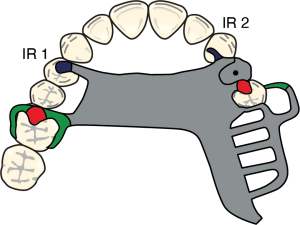
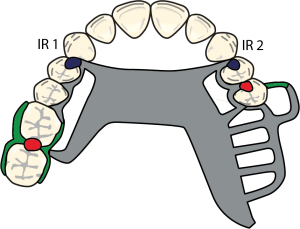
 

Figure 8-35. The auxiliary occlusal rest (IR 1) used on the first premolars, where the fulcrum axis intersects the opposing arch, functions as an indirect retainer. The canine extension (IR 2) on the edentulous side also serves as an indirect retainer, although it is less effective than the one on the opposing arch.
Figure 8-35. The auxiliary occlusal rest (IR 1) used on the first premolars, where the fulcrum axis intersects the opposing arch, functions as an indirect retainer. The canine extension (IR 2), on the edentulous side also serves as an indirect retainer, although it is less effective than the one on the opposing arch.
Figure 8-36. The auxiliary occlusal rest (IR 1) on the premolar opposite the free-end area provides more effective indirect retention because it is located farther from the fulcrum axis than the rest (IR 2) placed on the free-end side.
Figure 8-36. The auxiliary occlusal rest (IR 1), on the premolar opposite the free-end area provides more effective indirect retention because it is located farther from the fulcrum axis than the rest (IR 2) placed on the free-end side.

Cl III prostheses

Indirect retainers are not used in tooth-supported Class III prostheses (Figure 8-37).
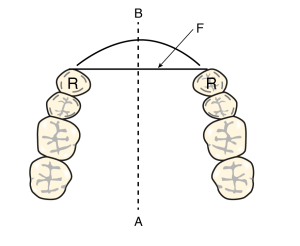
 

Figure 8-37. Occlusal rests on premolars in the opposing arch are used to support the major connector. Class III prostheses do not require indirect retainers.

CI IV prostheses

The ideal placement of indirect retainers according to the fulcrum axis is at points A and B; however, this is not possible (Figure 8-38). The prosthesis rotates around the fulcrum axis between points A and B.
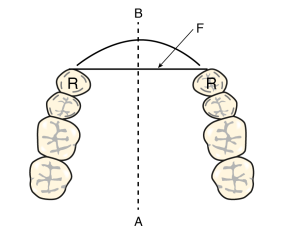
 

Figure 8-38. Indirect retainer positions (A and B) in Cl IV design (R: Retainer, F: Fulcrum axis).

To prevent rotation toward point A (separation of the anterior base from the mucosa), the denture base can be extended up to point A; however, this causes excessive tissue coverage and uses mucosal support, which is known to be less effective than tooth support.

Occlusal rests on the molar teeth on both sides act as indirect retainers, preventing the anterior denture base from lifting away from the mucosa (Figure 8-39).

To prevent rotation toward point B (tissue impingement of the base): The use of an indirect retainer at point B is not possible. The direct retainers located at point A, which are placed on the mesiobuccal undercuts of the first molars on both sides, simultaneously serve as indirect retainers (Figure 8-39).
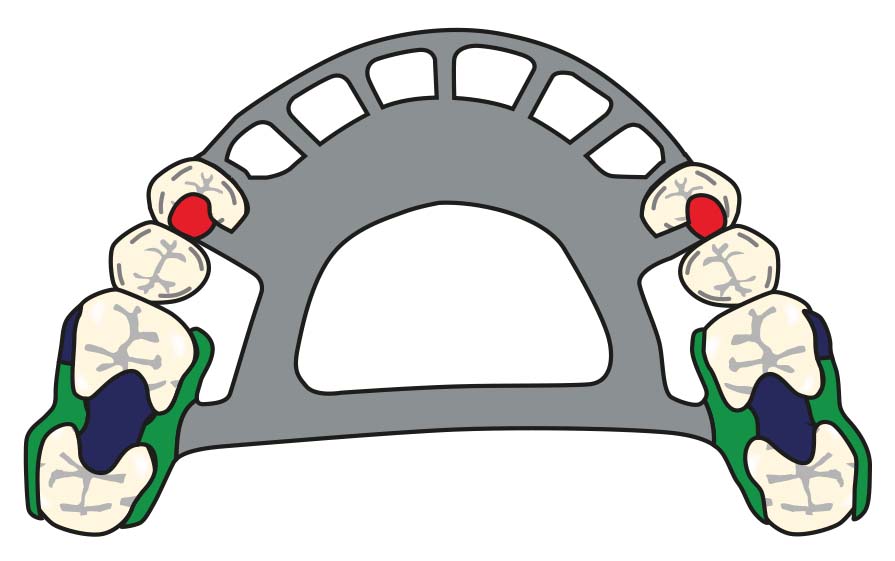
 

Figure 8-39. Embrasure rests used between molar teeth on both sides and Akers clasps placed on the mesiobuccal undercuts of the first molars on both sides act as indirect retainers.
Şekil 8-39. Embrasure rests used between molar teeth on both sides and Akers clasps placed on the mesiobuccal undercuts of the first molars on both sides act as indirect retainers.


License

A Guide to Removable Partial Denture Planning Copyright © 2025 by Funda Akaltan. All Rights Reserved.

Share This Book