
Tooth support
When determining teeth to serve as abutments for RPDs, their ability to resist functional stresses is a key consideration for ensuring controlled force transmission. The potential of a tooth to function as a reliable prosthetic abutment is assessed based on the following criteria:
- Periodontal health
- Crown-to-root ratio
- Crown and root morphology
- Position within the dental arch
- Opposing occlusion
Periodontal health
In evaluating abutment teeth for removable partial dentures, both clinical and radiographic findings must be carefully assessed. Since the terminal abutment teeth are subject to increased stress compared to non-supporting teeth, the quality and quantity of their alveolar bone support are of critical importance. Teeth exhibiting signs of periodontal lesions, infection, or clinical symptoms such as mobility or inflammation due to compromised periodontal tissues are not considered suitable abutments. In cases where a tooth has poor alveolar support, extraction followed by utilizing an adjacent, more stable tooth for support often yields better long-term outcomes.
Crown-to-root ratio
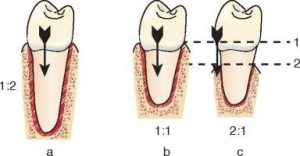
An ideal crown-to-root ratio of 1:2 provides favorable conditions for mechanical stability and functional support. The crown’s size and its axial alignment with the root allow for effective distribution of axial forces and proper placement of clasp components. A 1:1 ratio offers reduced support and stability, while a 2:1 ratio—where the crown is longer than the root—is considered inadequate. In such cases, the unfavorable crown angulation and its disproportion to the root and surrounding periodontal tissues compromise the transmission of occlusal forces (Figure 1-26).
Crown and root morphology
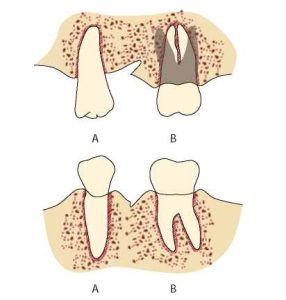
While teeth with cylindrical and thin-pointed roots have very low resistance to torque-type stresses, teeth with a large root surface within the bone exhibit the best tooth support properties (Figure 1-27).
Position within the dental arch
The position of abutment teeth within the dental arch is critically important for managing functional stresses and preventing potential damage to the supporting structures. Teeth that are misaligned, partially erupted, or have drifted or tilted due to previous tooth loss or other factors are generally less capable of effectively absorbing prosthetic forces. Therefore, unless absolutely necessary, such teeth should not be selected as abutments for removable partial dentures (Figure 1-28).
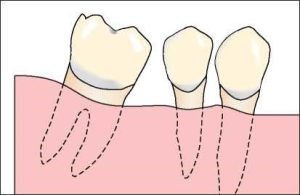
However, in cases where the use of such teeth as abutments is unavoidable, careful evaluation of prosthetic planning criteria is essential to ensure that stresses are either minimized or adequately controlled.
Opposing occlusion
The type of opposing occlusion and the number of teeth present in the opposing arch significantly influence the selection of abutment teeth. In individuals with natural dentition, occlusal forces can be up to ten times greater than those in patients wearing complete dentures. As a result, an abutment tooth used against a complete denture will be subjected to considerably less stress compared to one opposing natural dentition. Similarly, in cases where mutually protected occlusion is present, the teeth that bear the occlusal load are exposed to greater functional stress. Therefore, the supportive characteristics of these abutment teeth must be carefully evaluated during treatment planning.