
Factors affecting the severity of stresses transmitted to teeth and tissue supports
Residual ridge length
In proportion to the length of the edentulous span, the denture base also increases in length, increasing the stress applied to the abutment teeth. This is particularly important in distal extension cases, where the fulcrum line is located on or near the occlusal rest of the terminal abutment. In such situations, the length of the lever arm—defined by the extent of the denture base—directly affects the amount of force applied to the abutment tooth.
Residual ridge area
An increase in the surface area covered by the denture base leads to a more favorable distribution of occlusal forces, resulting in reduced pressure per unit area. For this reason, the denture base should be extended to cover the residual ridge as broadly as possible, while respecting the physiological tolerance limits of the adjacent soft tissues.
Impression technique
Residual ridges are considered to have both anatomical and functional forms. The anatomical form represents the shape of the ridge when it is not under occlusal load, and it is recorded using a low-viscosity impression material applied with relief provided throughout the tray. In contrast, the functional form is captured under pressure and reflects the tissue configuration during function.
The goal of functional impression techniques is to direct occlusal forces to areas capable of withstanding load, while minimizing stress on tissues that are unable to bear such forces. Therefore, when taking a functional impression in a partially edentulous arch, pressure should be directed toward the primary support areas—excluding highly resilient or excessively resorbed regions, as well as unfavorable soft tissues (Figure 1-24 ve Figure 1-25).
Distal-extension prostheses fabricated using anatomical impressions do not distribute masticatory forces evenly across the ridge, often transferring excessive load directly to the abutment teeth and the posterior alveolar bone beneath the denture base. This can result in traumatic stress in these regions. Functional impressions, by contrast, allow accurate registration of the primary support areas while preserving the anatomical form of regions where stress should be avoided.
Thus, the primary objective of a functional impression is to optimize support for the removable prosthesis, minimize rotational movement of the denture base that creates leverage on abutment teeth, and help maintain balanced occlusal contact between natural and artificial teeth.
Quality of ridge support
The form of the residual ridge plays a crucial role in distributing the forces generated during the function of an RPD. Broad and well-contoured ridges are capable of absorbing greater amounts of stress compared to narrow, slender, or knife-edge ridges. Parallel-sided, wide, and well-formed ridges contribute to the lateral stability of the denture and help reduce the transmission of stress to the abutment teeth.
The type of mucoperiosteum covering the ridges also affects the amount of stress transferred to the abutment teeth. A healthy mucoperiosteum approximately 1 mm thick can bear functional loads more effectively than thin, atrophic mucosa. Soft, thin, and mobile tissues may lead to excessive movement of the denture base, resulting in the transmission of traumatic stresses to the abutment teeth.
Direct retainer (clasp) characteristics
Clasp fit: A clasp designed to be completely passive when placed on the abutment tooth generates less stress on the supporting tooth.
During the insertion or removal of the prosthesis, the reciprocal arm should make contact with the abutment tooth before the retentive arm. This contact helps to reduce the stress applied to the abutment tooth when the retentive clasp engages the undercut area (the retentive region) of the tooth.
Clasp flexibility:As the flexibility of the clasp increases, the amount of stress transmitted to the supporting tooth decreases. However, flexible clasp arms contribute less to the lateral stabilization of the prosthesis. Therefore, as flexibility increases, both vertical and horizontal stresses transmitted to the residual ridges also increase.
Determining whether the residual ridges or the abutment teeth require greater protection is essential in the treatment planning process. If the abutment tooth has a healthy periodontal condition, wrought-wire clasp arms can be replaced with more rigid components such as bars or gingival clasps, which are still more flexible than circumferential clasp arms. These components transmit less harmful forces to both the supporting teeth and the edentulous ridges. Conversely, if the periodontal condition of the abutment tooth is compromised, a circumferential clasp with a wrought-wire retentive arm may be employed. While this configuration exerts minimal stress on the abutment tooth, it transfers a greater amount of force to the edentulous ridge.
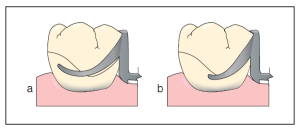
Clasp arm length: The clasp arm’s flexibility increases in line with its length. When the length doubles, flexibility increases fivefold. The length of the clasp arm can be increased by giving it a curved shape instead of a straight one, which reduces the load on the supporting teeth (Figure 1-29).
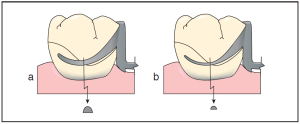
Clasp material: Clasps made from cobalt-chromium (Co-Cr) alloys exert more stress on the abutment tooth compared to those made from gold (Au) alloys due to the higher rigidity of the material—assuming all other factors such as clasp length and diameter remain constant. To increase the flexibility of Co-Cr clasps, their diameter is designed to be smaller than that of clasps made from Au alloys or wrought-wire clasps (Figure 1-30).
Abutment tooth surface: Crown restorations offer greater resistance to clasp arm movement than enamel surfaces. Therefore, abutment teeth restored with crowns are subjected to greater stress compared to unrestored abutment teeth.
Occlusal harmony
When irregular occlusal contacts are present between opposing teeth, destructive horizontal forces may develop on both abutment teeth and the residual ridge. The type of opposing occlusion can significantly influence the amount of stress generated by occlusal forces.
The area of the denture base that receives occlusal load determines the amount of stress transmitted to the abutment teeth and residual ridges. When occlusal forces are applied closer to the abutment teeth, the denture base exhibits less movement and transmits less stress to abutment teeth.
Ideally, occlusal forces should be directed toward the center of the load-bearing area of the denture base in both antero-posterior and bucco-lingual directions. Typically, the second premolar and first molar regions are most affected by masticatory forces. Therefore, the artificial teeth to be used in the prosthesis should be positioned with the understanding that the majority of the chewing load will be concentrated in these areas.