
Occlusal rests
The occlusal rest is a type of rest that frequently extends onto the mesio-occlusal or disto-occlusal surfaces of two or more molar or premolar teeth, in order to provide support through the abutment teeth and to restore occlusal anatomy in accordance with the occlusal plane (Figure 2-3).
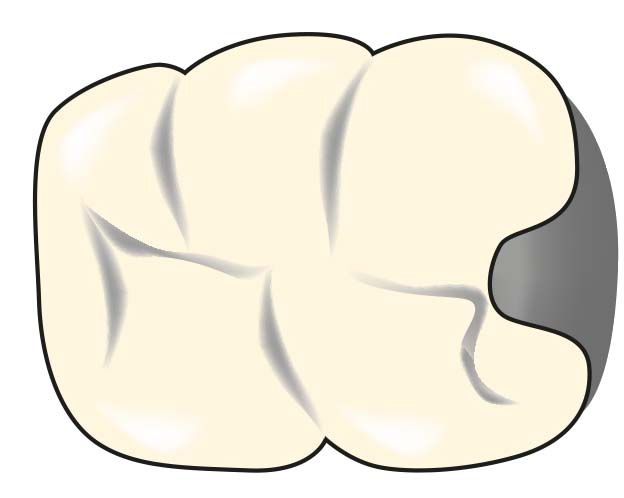
When the rest is located on only one side of the abutment tooth, it transmits a significant portion of the occlusal load to that side, which may cause the tooth to tip. This situation is advantageous in teeth that extend beyond the occlusal plane. In the presence of areas that create occlusal interference, it may be necessary to use the rest on a surface other than the proximal of the tooth (Figure 2-4).
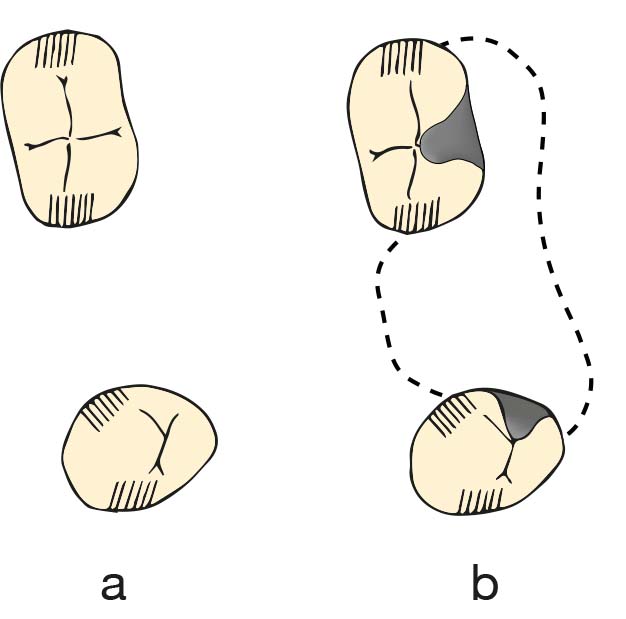
a) Occlusal contact areas on the mesial and distobuccal surfaces of the premolar tooth and the mesial and disto-occlusal surfaces of the molar tooth. b) Occlusal rest placement on the distolingual surface of the premolar tooth and the lingual surface of the molar tooth.
Making a crown restoration should be necessary to get the abutment tooth to its original position in the arch before attaching a clasp to a rotated tooth. However, if for any reason the abutment tooth cannot be restored, it may be possible to modify the axial surfaces for clasping, using the occlusal rest in the buccal or lingual areas instead of the mesial or distal fossa. If placing the rest in these areas is impractical, an appropriate rest seat can be prepared, and any part of the abutment tooth may be used for support.
The occlusal rest restores occlusion in teeth that cannot reach an appropriate occlusal position and in cases where vertical dimension loss occurs due to tooth wear. To preserve the remaining teeth, forces must be transmitted along the long axis of the tooth and the direction of the periodontal ligament. In a tooth-supported case, for this to be achieved, the rest should extend at least to the center of the abutment tooth. By extending the rest to the center of the abutment tooth, the force is transmitted equally to both roots, both sides of the periodontal ligament, and then to the bone, which is the most advantageous force transmission method. The width of the rest is about one-third of the tooth’s buccolingual width. The occlusal rest should be wide and relatively thin, rather than narrow and thick, to provide a resistant structure and not to interfere with occlusal contacts.
In mandibular molars that are excessively inclined mesially, when forces cannot be transmitted along the long axis of the tooth, occlusal forces will cause the tooth to tip further. In this case, an additional occlusal rest can be used on the distal surface, in addition to the mesial, to prevent further mesial tipping of the tooth.
Extended occlusal rest
Modified occlusal rests are used for splinting periodontally compromised teeth or for controlling the position of teeth lacking opposing contacts. Due to periodontal or systemic diseases, teeth often lose bone support and shift from their original positions, resulting in the loss of proper occlusal relationships. An extended or continuous occlusal rest may function like a stabilizing appliance. It provides positive occlusal contact and support in or around centric contact areas and helps reduce lateral forces on the abutment teeth during eccentric movements. While the rest can be designed to extend across the occlusal surfaces of two or more teeth, in certain cases it may span the entire arch (Figure 2-5).
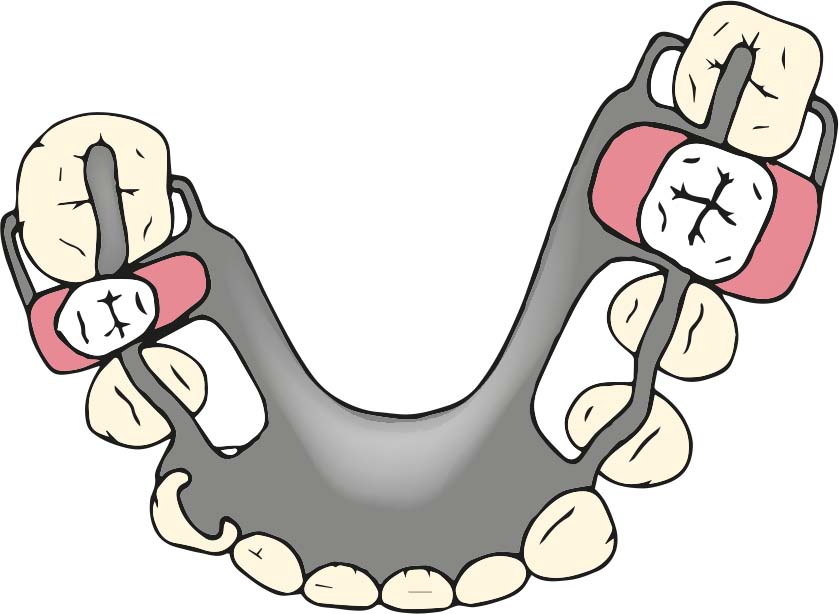
When an occlusal force is applied to a specific region, all the teeth function as a single unit to provide support. By restoring the occlusal plane, support is achieved and the dental arch is splinted.
If the fossa is deep and the opposing cusp fits tightly into it, excessive lateral forces may develop during function—forces that the supporting tissues cannot withstand. These lateral stresses can be minimized and made easier to tolerate by lowering the height of the opposing cusp and positioning the rest to fill the deep fossa.
Embrasure occlusal rest
The design of the direct retainer may necessitate the use of embrasure (interproximal) occlusal rests. The use of two adjacent rests offers advantages in distributing occlusal forces and preventing the interproximal wedging effect of the metal framework. Additionally, it helps deflect food away from the contact points between the teeth (Figure 2-6).
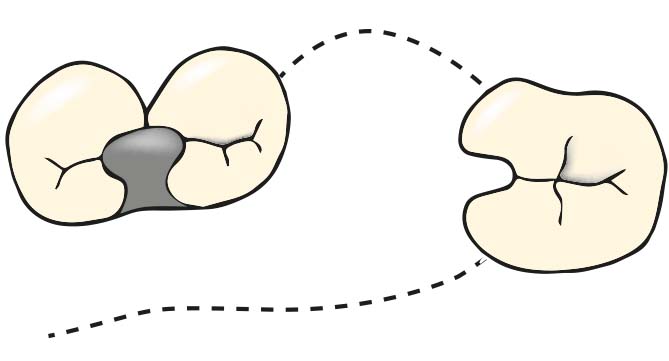
When preparing the rest seats for embrasure occlusal rests, it is essential not to eliminate the contact points of the abutment teeth. Some tooth structure is removed to provide sufficient bulk for the metal, ensuring its durability. However, to prevent the minor connector from exerting a torque effect on the abutment teeth, the creation of a vertical slot must be avoided, and the occlusion should never be altered (See Mouth Preparation; Chapter 10).