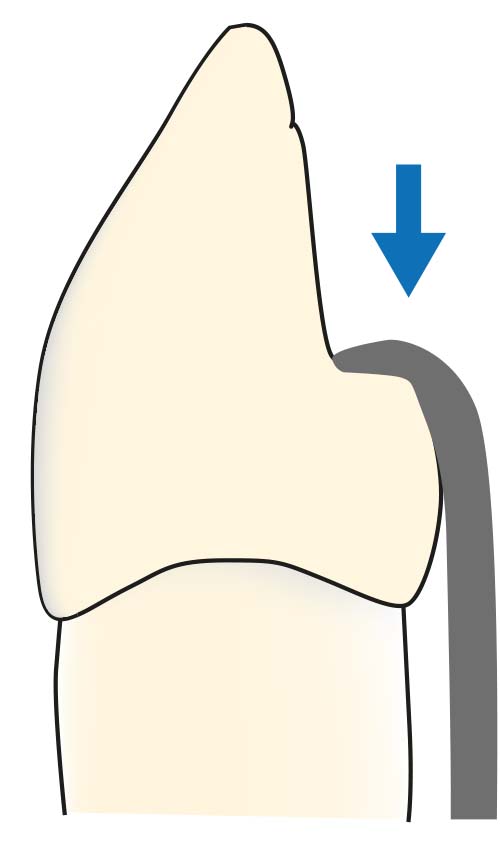
Cingulum rest
The cingulum rest is a type of rest placed on the lingual (cingulum) surfaces of anterior teeth. These surfaces are inclined and lack distinct anatomical features such as a central fossa or marginal ridge, making the placement of the rest challenging. Its major disadvantage is that it is placed on an inclined surface. Forces acting on such a surface generate lateral stresses on the abutment tooth, which may ultimately lead to tooth loss (Video 2-7).
When determining the shape and size of rests placed on incisors, factors such as root form, root length, tooth inclination, and the clinical crown-to-root ratio should be evaluated. Compared to central and lateral incisors, the canine tooth is more suitable for rest placement; however, when it is not available, placing multiple rests on several incisors or having support from the major connector—lingual plate or horseshoe plate—is preferable to relying on a single incisor.
Due to the morphology of anterior teeth, preparing a singulum rest seat on enamel can be challenging. The enamel near the gingival margin is thin, and there is a risk of dentin exposure when attempting to prepare a rest seat of sufficient depth. However, in maxillary canines that possess a prominent singulum with adequate enamel, it may be possible to prepare rest seats with appropriate contours (Figure 2-8).
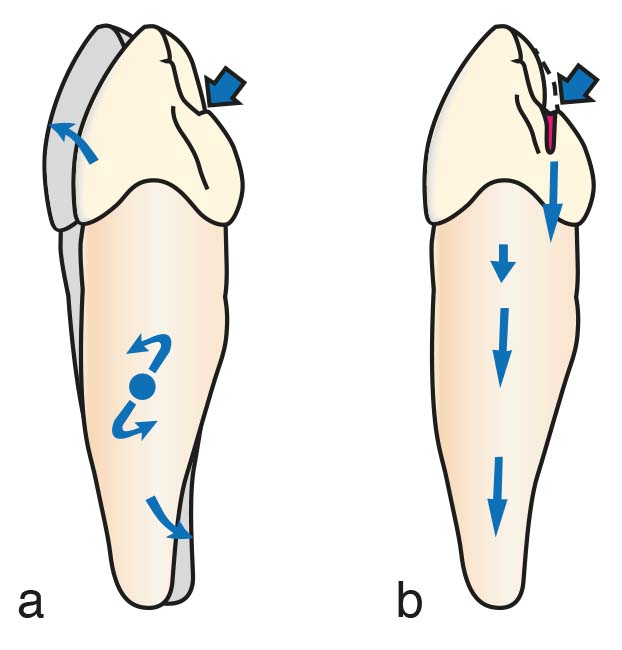
a) Failure in the absence of rest seat preparation.
b) When appropriate tooth preparation is performed, forces are transmitted along the long axis of the tooth.
Furthermore, the occlusal relationship with the opposing arch must be carefully considered. In cases where the antagonist teeth contact the singulum or palatal surface of the abutment tooth with the cingulum rest, it is advisable to reduce the height of the opposing tooth, rather than excessively modifying the singulum to accommodate the rest.
The lingual surfaces of mandibular canines and incisors, with their small or often nonexistent singulum, have an inclined shape. This makes the preparation of a singulum rest seat impossible.
In cases where the anterior teeth do not have morphological features to support the singulum rest, their lingual surfaces can be modified with a crown restoration, allowing appropriate preparation of the rest seat. This method is more commonly used for mandibular canine teeth (Figure 2-9).