
Selecting the major connector
The major connector should be selected in accordance with its indication, taking into consideration factors such as the anatomical features of the case, the location and number of edentulous spaces, the need for splinting of the teeth, or the necessity of providing indirect retention through the major connector.
Maxilla
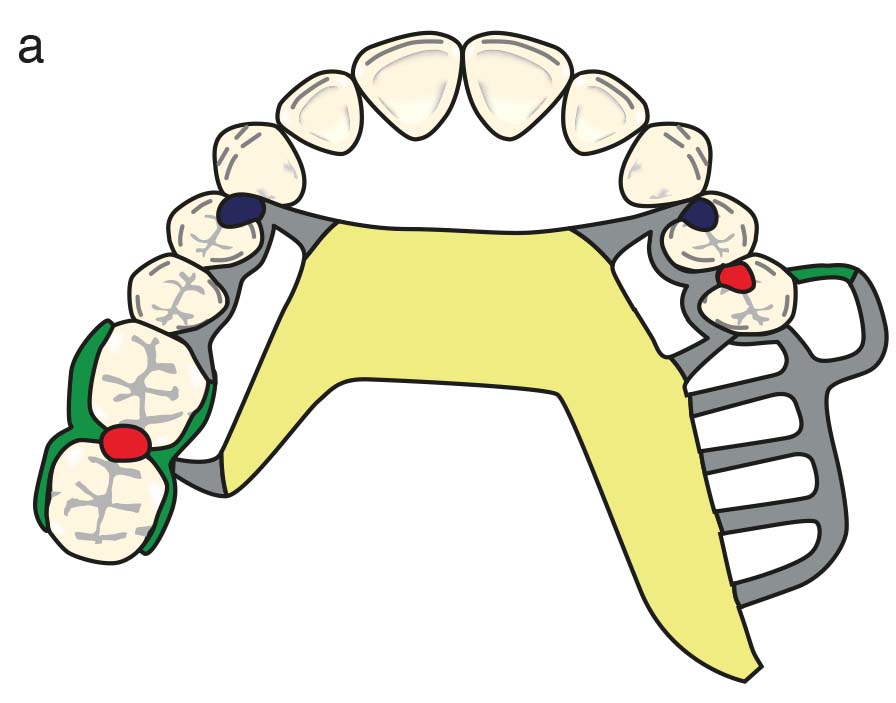
- When the remaining teeth have adequate periodontal support and the need for additional tissue support is minimal, a palatal strap or an anteroposterior palatal bar may be used (Figure 8-40).
The palatal strap is the most comfortable major connector for the patient (Figure 8-40a); however, it should not be used in the presence of long bilateral distal extension edentulous spaces, as it may become deformed due to the multi-axial rotations of the denture base.
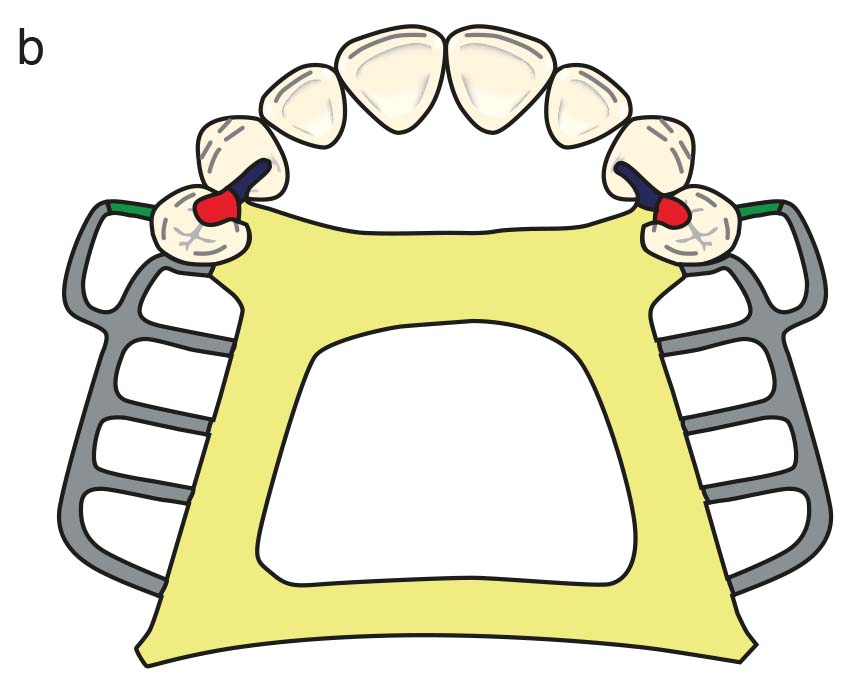
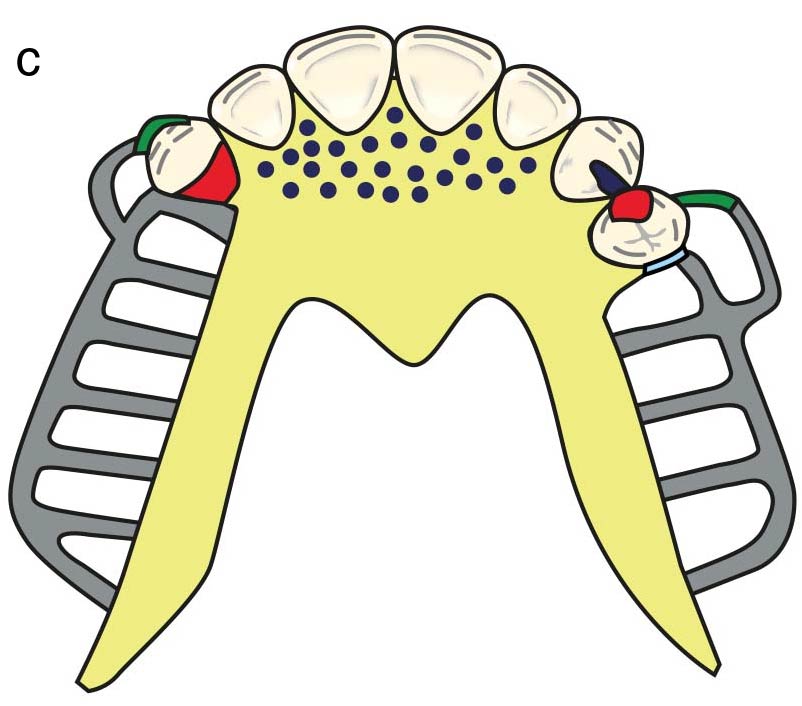
For Class I prostheses, the most rigid and biomechanically advantageous major connector is the double palatal bar (anteroposterior bar) (Figure 8-40b); however, since most patients cannot tolerate the posterior bar, the second-best option in such cases is the U-shaped palatal plate (Figure 8-40c).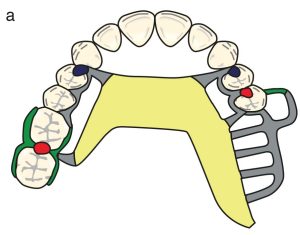
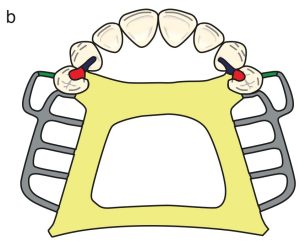
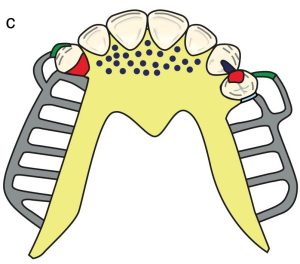
Figure 8-40. Major connector options when tissue support is not required. a) Palatal strap b) Anteroposterior palatal bar c) U-shaped palatal plate - In distal extension cases, especially when there are only two or fewer incisors, when the abutment teeth in the anterior region are asymmetrically distributed along the arch, or when the periodontal health of the teeth is compromised, the need for increased tissue support and retention makes the use of a complete palatal plate more appropriate.
However, in such cases, rather than fabricating the entire plate from metal, it is more advantageous in terms of retention, lightness, and thermal insulation to design only the rugae area in metal and to form the posterior part and post-dam region from acrylic resin (see: Major connectors). Chapter 5, Figure 5 -10). - In distal extension cases with long edentulous spans, the rigidity of the major connector is of critical importance; in such situations, the most appropriate options are the anteroposterior palatal bar or the complete palatal plate.
- When there are few abutment teeth located anterior to the fulcrum line or when suitable tooth surfaces for rest placement are not available, indirect retention must be provided via the major connector. In these cases, a U-shaped palatal plate covering the rugae, an anteroposterior bar, or a complete palatal plate may be used (Figure 8-40c).
- When an edentulous space exists in the anterior region, a U-shaped plate, a modified anteroposterior bar with an extended anterior segment, or a complete palatal plate is indicated. Key factors in decision-making include the number and location of missing posterior teeth, the periodontal support of the remaining teeth, and the type of opposing occlusion.
- In the presence of a torus that cannot be surgically removed, an anteroposterior palatal bar or a U-shaped plate is appropriate.
- However, when selecting a U-shaped plate, it should be noted that its lack of rigidity may result in concentration of forces on the abutment teeth or the edentulous ridges.
- To enhance rigidity, distribute lateral stresses, improve indirect retention, and avoid the creation of food trap areas, the borders of the major connector may be extended onto the palatal surfaces of the remaining teeth.
Mandible
- In tooth-supported cases, the lingual bar is the simplest and most comfortable major connector of choice.
- When the anterior teeth have compromised periodontal support and require splinting, a lingual plate is preferred. If diastemas are present between the anterior teeth, an interrupted linguoplate is indicated. A double lingual bar may also be used; however, there must be sufficient vertical space (6–8 mm) between the gingival margins and the floor of the mouth.
- When only anterior teeth are present, indirect retention must be provided solely by the major connector; therefore, the use of a linguoplate or a Kennedy (cingulum) bar becomes mandatory.