Anterior teeth
Porcelain or acrylic resin artificial teeth
When properly arranged, this is considered the most esthetic approach. A wide range of shades, sizes, and shapes is available. Additional customizations such as simulating wear or flattening contact areas can also be achieved. A major advantage over other alternatives is the possibility of positioning these teeth on the labial flange, particularly when significant alveolar bone loss is present in the anterior region, allowing for improved lip support and facial symmetry.
When a flange is not required, the teeth can be placed in direct contact with the alveolar ridge, resulting in a more natural esthetic outcome. However, due to their inability to adequately withstand functional stresses in the anterior region, this option may not be suitable for replacing single missing teeth, as the teeth may become detached from the denture base.
Porcelain or acrylic resin facings
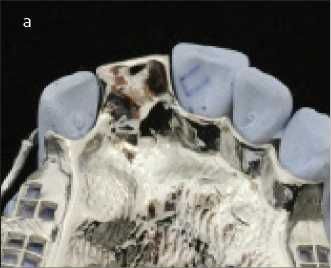
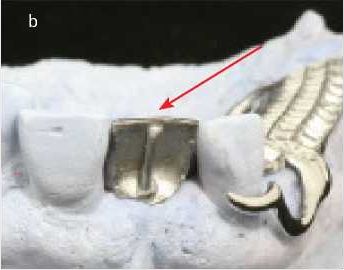
These facings are preferred in cases where the mesiodistal width of the edentulous space and the interocclusal distance are limited, due to their superior durability. The metal substructure that will support the restoration of the edentulous area is fabricated as an integral part of the removable partial denture framework (Figure 6-5).
 |
 |
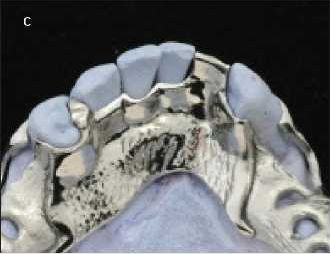 |
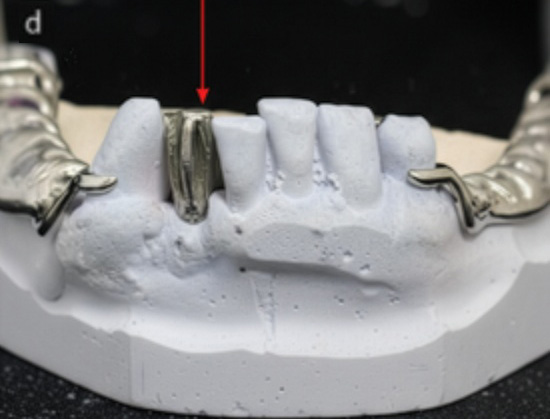 |
The prefabricated facings, matched to the tooth shade, are attached by the dental technician (Figure 6-6).
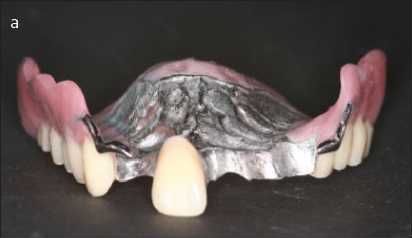
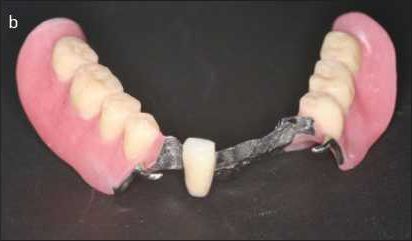
The lingual half of the artificial tooth, when shaped from cobalt-chromium as part of the metal framework, may affect the shade of the acrylic resin or porcelain. Achieving a color match with adjacent natural teeth is also challenging. If the facing material is prepared too thinly, the perceived depth and natural appearance are compromised.
In cases of deep vertical overbite, constant contact of the opposing tooth with the metal surface can lead to rapid wear. For a natural appearance, the facing should be positioned as if it emerges from the edentulous ridge. This requires a broad and healthy ridge. However, in the event of subsequent bone resorption, relining or rebasing of the denture base cannot be performed.
Tube Teeth
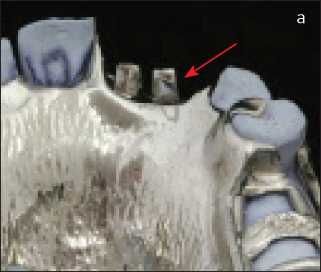
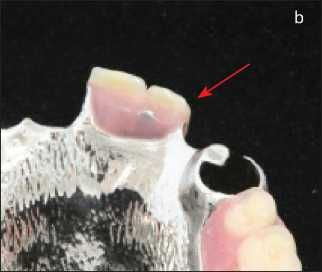
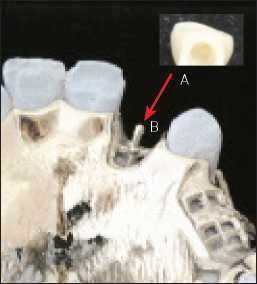
A tube tooth (or pin tooth) is a porcelain or acrylic resin artificial tooth that contains a vertically oriented canal or tube-shaped cavity extending upward from its base (Figure 6-7). During the wax-up of the metal substructure, a corresponding pin is formed. After casting, the tube tooth is cemented onto this pin.
The entire structure of the tooth is made of either porcelain or acrylic resin, generally providing good esthetics. Shade matching is relatively easy due to the material’s thickness, which allows for natural translucency. However, to achieve a lifelike appearance, a wide and non-resorbed residual ridge is required. Tube teeth exhibit a level of resistance that lies between conventional artificial teeth and facings. Due to their limited retention, they are not recommended when mesiodistal or occlusogingival space is restricted. They are best suited for the replacement of a single missing tooth and are not advisable for multiple tooth replacements. Tube teeth do not derive support from the underlying tissues, and relining or rebasing procedures in this region cannot be performed.
Reinforced acrylic resin pontics
These are particularly suitable for the anterior region and the maxillary first premolar area. This method combines the advantages of both facings and tube teeth. In reinforced acrylic resin pontics, the gingival half of the lingual surface is composed of a projection or a metal ring that surrounds the area where the artificial tooth will be attached. This metal component provides additional strength and durability (Figure 6-8).
Therefore, they can also be used in areas with limited space. Occlusal contact with the opposing teeth is established through the acrylic resin, which helps control wear on the antagonist teeth. The incisal half of the hard plastic contributes to shade matching and provides good esthetics.
As with facings or tube teeth, a healthy residual ridge is required; these pontics receive minimal support from the underlying tissues, and relining or rebasing in this area is not possible.