
Balancing the stress transmitted to teeth and edentulous areas
Reducing the number of artificial teeth in the posterior region
By reducing the number of artificial teeth in the denture base of the posterior region, the aim is to limit the area of the denture exposed to masticatory forces.
Reducing the buccolingual width of artificial teeth
Another method of narrowing the area of the denture exposed to masticatory forces is the selection of artificial teeth with reduced buccolingual width. This not only decreases the amount of force transmitted to the tissues beneath the denture base, but also limits the amount of movement in the denture base under force, thereby minimizing the torque transmitted to the abutment teeth.
Preservation of the sharpness of the cusps
During occlusal adjustments, the sharpness of the cusps of the artificial teeth is preserved to enhance masticatory efficiency while minimizing the required masticatory forces for function. In this way, the amount of stress transmitted to the supporting tissues is controlled.
Neuromuscular control
The patient’s ability to control the movements of the lips, cheeks, and tongue plays a key role in the retention of the prosthesis and, consequently, in reducing the stress transmitted to the supporting tissues. However, the design of the denture base and its polished surfaces significantly affect the patient’s ability to maintain the prosthesis in place.
Rigid major connector
To reduce movements around different fulcrum axes in the distal extension denture base and ensure that the load is distributed evenly across both sides of the arch, including the abutment teeth and edentulous areas, the major connectors must be rigid. By extending the denture base with a rigid major connector to the teeth on the opposite side of the arch and supporting the prosthesis with various direct retainers, denture base movements and stresses can be minimized.
Direct retention
In the retention of the prosthesis and the control of stresses, the relationship between the abutment tooth’s height of contour and the position of the retentive clasp arm is more important than the number of clasps, as the retentive clasp arm is the component of the partial denture that transmits potentially damaging forces to the abutment teeth. In the planning of RPDs, the use of an excessive number of clasps has become a common practice. The number of clasps to be used in the treatment planning of RPD is based on the modification spaces in the Kennedy classification; however, one of the most common mistakes is placing a clasp on every abutment tooth, which is an incorrect approach.
The ideal clasp configuration is the quadrilateral design. In a prosthesis securely supported by four clasps, both retention and leverage effects are balanced (Figure 1-37).
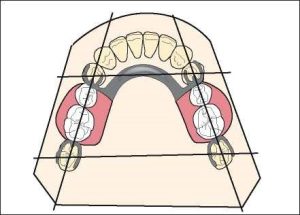
When determining the positions of the clasps, those on both sides are placed on the most posterior teeth possible, while the others are positioned in the anterior region to the extent allowed by aesthetics.
The triangular (or tripod) design, which involves three abutment teeth, is also advantageous. By keeping the abutments as far apart as possible, the retentive clasps and the prosthesis will be positioned over the widest possible area (Figure 1-38).
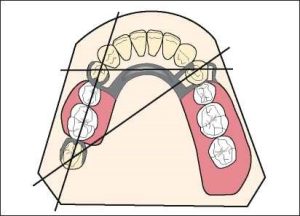
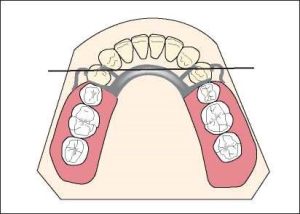
The triangular clasp design is the most ideal clasp configuration in Class II cases with modification spaces.The bilateral clasp design, typically achieved by using one clasp on each side of the dental arch, is not as advantageous as other designs. However, when the number of abutment teeth is limited, it is unfortunately the only option. Clasps are used on both sides of the arch without considering the position of the terminal abutment teeth. The resistance of the clasps in the bilateral design to the leverage-induced stresses created by the denture base is minimal (Figure 1-39).
Indirect retention
By preventing the distal extension denture base from rotating away from the mucosa around the fulcrum axis, the indirect retainer helps to promote stability by preventing denture base movement. The indirect retainer, which is situated on the other side of the fulcrum axis in relation to the denture base, makes use of the lever’s mechanical advantage and only functions when the denture base rotates away from the mucosa around the fulcrum axis (See: Indirect Retainers; Ch 4).