
Determining the supporting units
Identification of the tooth and mucosal supports is necessary in order to prevent the prosthesis from moving toward the underlying tissues. Tooth support is provided by rests, whereas tissue support is obtained through the distal extension denture base.
Tooth Support
The terminal abutment teeth adjacent to the edentulous areas that define the classification, and the secondary abutment teeth adjacent to modification spaces and often utilized for cross-arch support, offer more favorable support than mucosal tissues. Among prosthetic components, the most effective means of achieving tooth support is through the use of rests.
Rests
Rests are the first prosthetic components considered during the planning phase. A rest is placed on the abutment tooth (or teeth) adjacent to each edentulous space, including modification areas. The number and location of the rests are determined by the following factors:
- The number of edentulous spaces
- Whether the edentulous span is tooth-supported or a distal extension
- The type of major connector to be used
Rests may also be required to support the major connector; in such cases, additional rests are planned following the selection of the major connector.
Occlusal Rests
In Class I and Class II removable partial dentures, occlusal rests are placed on the molar and premolar abutment teeth adjacent to each edentulous space.
Placing occlusal rests into properly prepared rest seats allows functional forces to be transmitted along the long axes of the teeth, which is biomechanically advantageous.
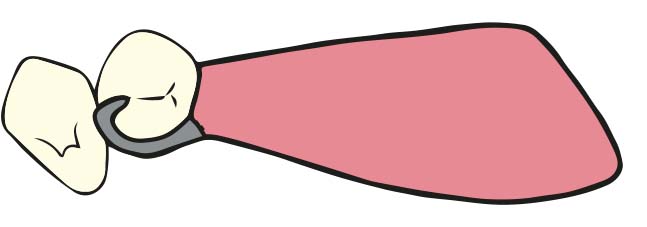
In cases involving distal extension denture bases, occlusal rests are positioned on the mesio-occlusal surfaces of the molar and premolar abutment teeth adjacent to the edentulous area (Figure 8-1).
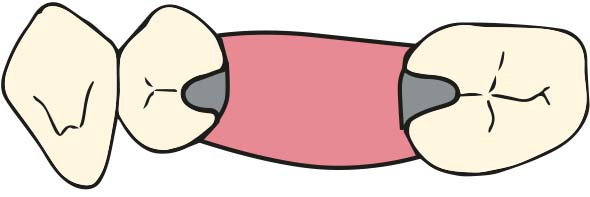
In Class III removable partial dentures, occlusal rests are placed on the surfaces of the abutment teeth closest to the edentulous ridge (Figure 8-2).
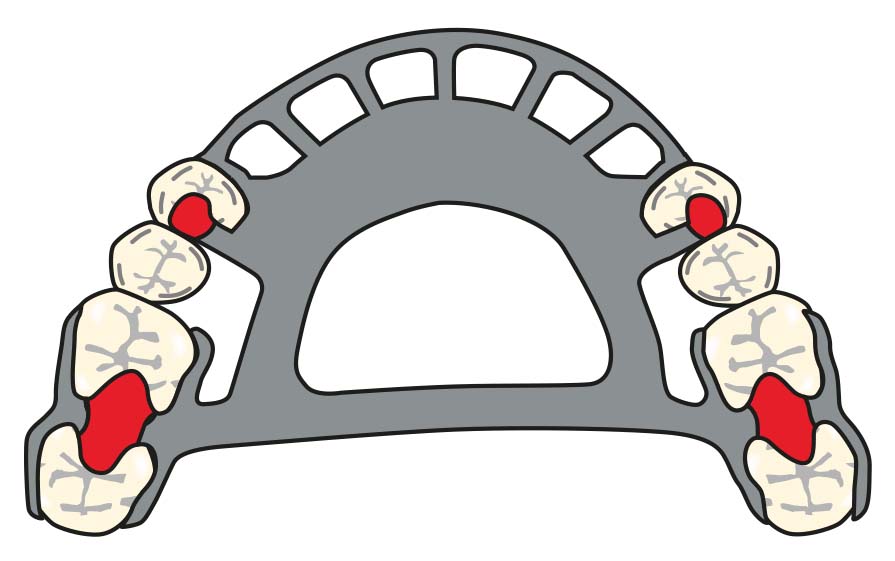
In Class IV removable partial dentures, rests are placed on the abutment teeth adjacent to the edentulous space, as well as on the two most posterior abutment teeth on both sides to provide distal support for the major connector (Figure 8-3).
There are special circumstances that override the general rules regarding the position of occlusal rests:
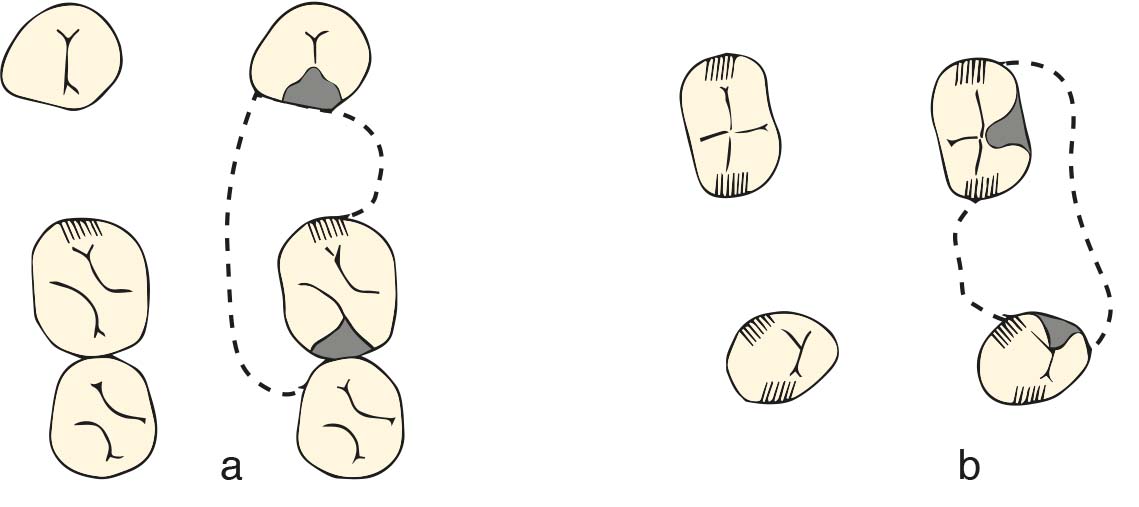
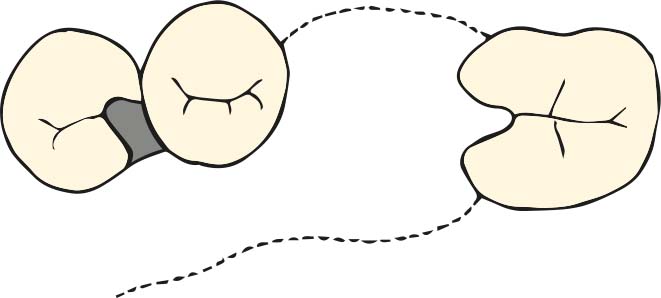
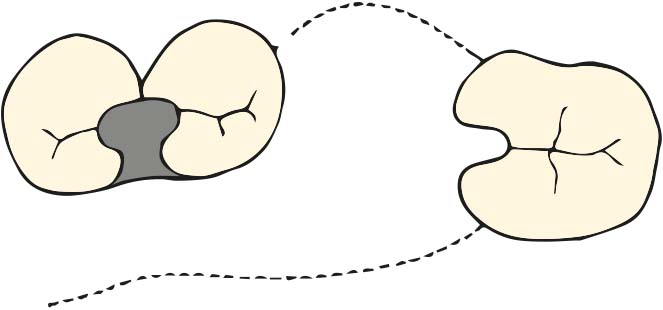
Occlusal rests must never be placed in areas that interfere with natural occlusal contacts. In such cases, the rest should be relocated to the opposite side of the tooth or to an adjacent tooth (Figure 8-4).
When the abutment teeth have poor periodontal support, the occlusal rest may be placed on the adjacent tooth (Figure 8-5), or the load can be distributed by positioning the rest together on two abutment teeth (Figure 8-6).
Cingulum Rests
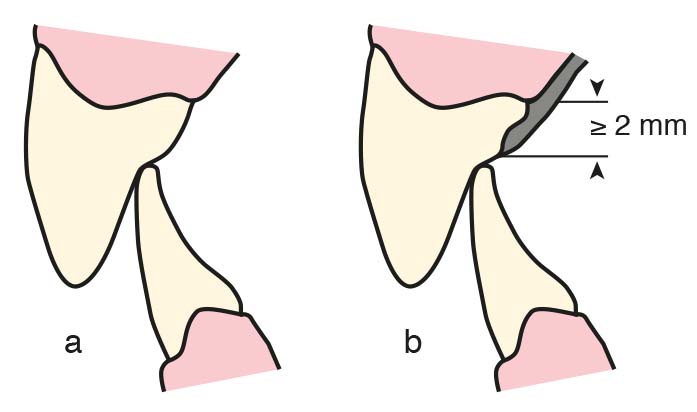
The cingulum rest is placed on the cingulum or, if the anatomy does not permit, in place of the cingulum. When occlusal contact exists on the cingulum with the opposing tooth, the cingulum rest is positioned anywhere between this contact point and a point 2 mm above the gingival margin (Figure 8-7). If there is insufficient space to accommodate this arrangement, an occlusal rest on another tooth is considered, or a rest seat is prepared.
Tissue Support
Tissue support is important in distal extension bases and tooth supported partially edentulous cases with large edentulous areas. Since the base of distal extension removable partial dentures is predominantly mucosa-supported, it should cover as wide an area as possible. This helps to reduce the load per unit area transmitted to the terminal abutment teeth.
Although the retention of a removable partial denture does not depend entirely on the boundaries of the denture base, replicating the sulcus anatomy is important for stability and support. When the denture borders are kept too short, most of the support is lost, resulting in excessive load being transferred to the abutment teeth. Conversely, if the borders are excessively long, the surrounding tissues may suffer trauma due to muscle’s functional movements. Muscle attachments reduce the effectiveness of direct retainers and can cause denture displacement.