Maxillary Kennedy Cl III
Maxillary Kennedy Cl III
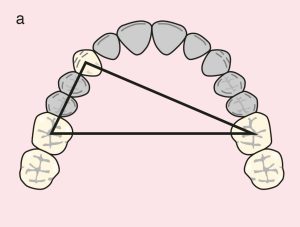
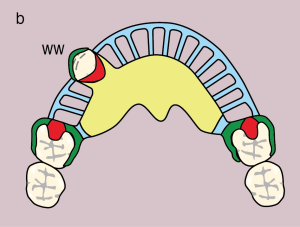
Case 26. Figure 11.26
Case description and design parameters
Case classification:
A single tooth-supported edentulous area; Class III
Support areas:
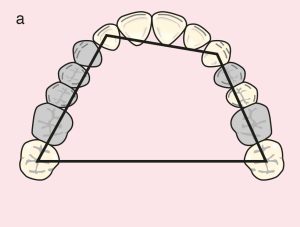
Tooth support: Terminal abutments; quadrilateral support plane formed by the terminal abutments of teeth 24, 28, 14, and 17
Occlusal rests: 14 and 24 (DO), 17 and 28 (MO)
Guide planes:
Tooth-supported: 24 (D), 28 (M)
Direct retainer:
Akers clasps; 14 and 24 (MB undercut), 17 and 28 (DB undercut)
If interocclusal space is insufficient, the clasp on tooth 14 may be omitted; in this case, only the occlusal rest (DO or MO) is used to support the major connector.
Reciprocation:
Reciprocating clasp arm
Indirect retainer:
Not required due to the absence of a distal extension base
Major connector:
Palatal strap
Minor connectors:
Elements connecting the clasps and artificial teeth to the major connector
Denture base and artificial teeth:
Tooth-supported base; metal-acrylic base and acrylic artificial teeth
Maxillary Kennedy Cl III modifications
Case 27. Figure 11.27
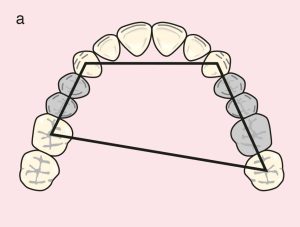
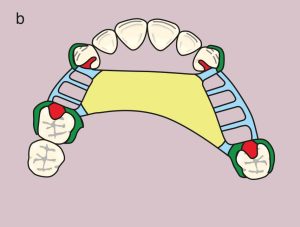
Case 28. Figure 11.28
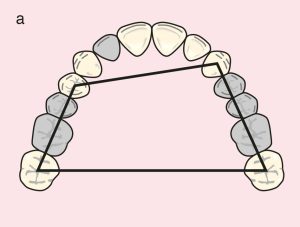
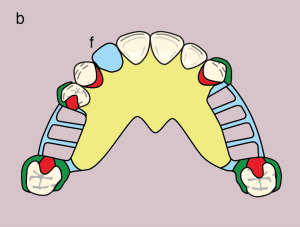
Case classification:
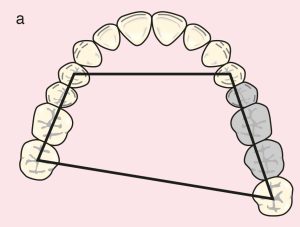
Three tooth-supported edentulous areas; Class III Mod 2
Support areas:
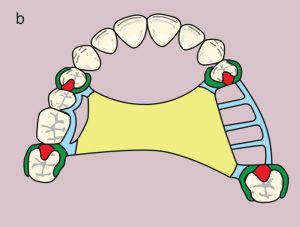
Tooth support: Quadrilateral support plane formed by the terminal abutments of teeth 23, 27, 14, and 17
Secondary abutments: 11, 13, and 14
Occlusal rests: 17 and 27 (MO), 14 (DO)
Cingulum rests: 13, 11, and 23
Guide planes:
Tooth-supported: 11, 14, 23 (D) and 13, 17, 27 (M)
Direct retainer:
Akers clasps: 14 (MB undercut), 17 and 27 (DB undercut); gingival clasp: 23 (MB undercut)
Reciprocation:
Proximal plate and cingulum rest: 23; reciprocating clasp arms: 14, 17, and 27
Indirect retainer:
Not required due to the absence of a distal extension base
Major connector:
U-shaped plate
Minor connectors:
Elements connecting the clasps and artificial teeth to the major connector
Denture base and artificial teeth:
Tooth-supported base; metal-acrylic base with acrylic artificial teeth and facing tooth
Case 29. Figure 11.29
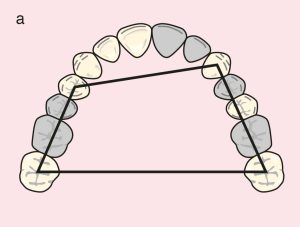
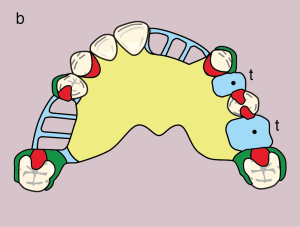
Case 30. Figure 11.30
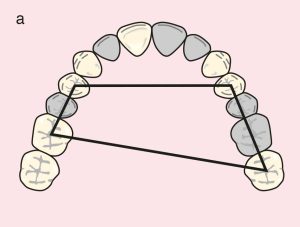
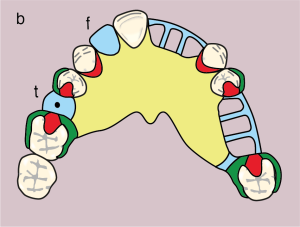
Case 31. Figure 11.31
Case 32. Figure 11.32