
Functional components of a clasp
Although clasps placed on abutment teeth are primarily designed to provide retention for the partial denture, their structural components also serve additional functions. From a functional perspective, a circumferential clasp consists of two arms (a retentive arm and a reciprocal arm), a rest, and a minor connector. The minor connector constitutes the body of the clasp.
In bar clasps or gingivally approaching clasps, the minor connector that joins the retentive arm to the metal framework is referred to as the approach arm (Figure 3-1).
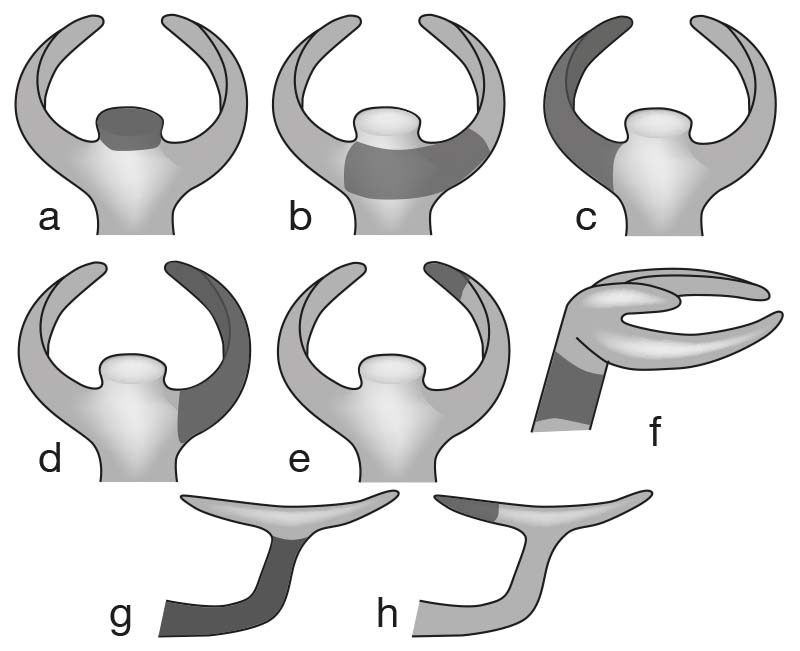
a) Rest: Provides support to the denture by engaging the abutment tooth.
b) Body: Connects the rest and clasp arms to the minor connector.
c) Reciprocal arm: Located above the survey line, it provides stabilization.
d) Retentive arm: Includes both the shoulder and the terminal retentive tip.
e) Retentive tip: The terminal one-third of the retentive arm, located below the survey line, which provides direct retention.
f) Minor connector: Joins the clasp body to the metal framework.
g) Approach arm: A type of minor connector in bar clasps that connects the body and retentive tip to the framework.
h) Retentive tip of a bar clasp: Positioned below the survey line, this part of the bar clasp provides retention.
Retentive arm
The function of the retentive arm is to resist displacement of the clasp on the tooth, thereby helping to maintain the denture in its proper position within the oral cavity.
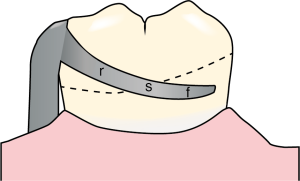
The survey line represents the greatest circumference of a tooth in a given horizontal plane. During cast surving, this line—also referred to as the height of contour—is identified on the abutment tooth using a surveying tool. The survey line divides the tooth surface into two zones: the undercut – retentive – area (below the line) and the nonundercut – nonretentive – area (above the line). The retentive arm is designed with graduated flexibility: the terminal one-third, which engages the undercut, is flexible; the middle third is semi-flexible; and the proximal third, which joins the clasp body, is rigid. While the terminal portion of the retentive arm provides retention, the other segments prevent vertical displacement and contribute to horizontal stability (Figure 3-2).
Reciprocal arm
The reciprocal (stabilization) arm of the clasp is positioned on the surface of the abutment tooth opposite to the retentive arm. Its function is to counteract any stress exerted on the tooth by the retentive arm. The reciprocal arm is entirely rigid, contributing to horizontal stability. Due to its contact with the tooth surface, it also provides a degree of support and offers limited retention.
Occlusal rest
The occlusal rest connects the retentive and reciprocal arms of the circumferential clasp. It is placed in a prepared rest seat on the tooth surface, resisting displacement of the clasp in the gingival direction. Additionally, it contributes to stabilization by limiting movement in the horizontal plane.
Minor connector
The minor connector is the body portion that connects the arms and rest of the clasp to the metal framework.