
Determining the denture base and artificial teeth
Denture base
In distal extension edentulous areas or tooth-supported edentulous spaces requiring a removable prosthesis shortly after tooth extraction, acrylic bases suitable for relining are used.
Especially in cases involving a single tooth or tooth-supported edentulous spaces, both metal and acrylic bases may be preferred.
To ensure the occlusal stresses are distributed over a wide area, the borders of the distal extension base should be kept as broad as possible without interfering with the functional movements of the surrounding tissues.
The polished surfaces are prepared to enable the patient to achieve maximum neuromuscular control.
For distal extension bases, functional impressions are employed to obtain the functional form of the residual ridges.
Benefits of functional impression:
- The support, stability, and retention obtained from the abutment teeth and edentulous areas are clearer and more accurate.
- The resilience difference between the abutment teeth and edentulous tissues is reduced.
- Pressure is directed toward healthier and load-bearing areas.
- Under the influence of masticatory forces, the denture base exhibits less movement; forces are distributed evenly between the abutment teeth and edentulous areas; the mucosa and bone of the abutment teeth and residual ridge are preserved.
- Since the base experiences less displacement under occlusal loads, occlusal contact between the denture teeth and opposing natural teeth is maintained, enhancing masticatory efficiency.
Artificial teeth
In cases of a single tooth missing in the anterior region, faceted teeth, and in the premolar region, tube teeth are more advantageous options in terms of durability and aesthetics for prosthetic teeth (Figure 8-42).
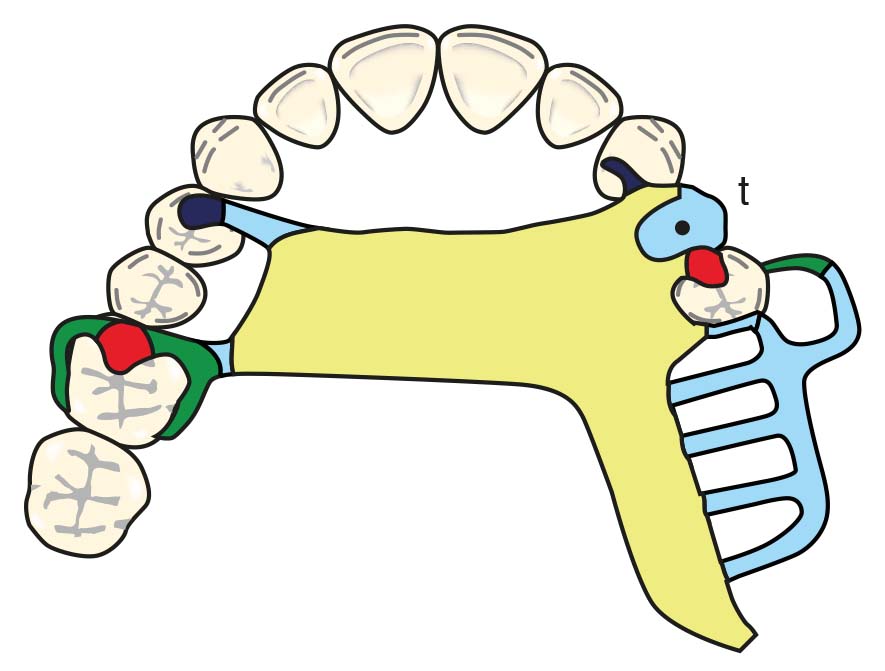
In cases of missing mandibular molars with a narrowed edentulous space, metal teeth or metal frameworks may also be considered as options.
Once the treatment plan is finalized, each prosthetic component should be clearly and completely indicated on the diagnostic cast to avoid any misunderstandings, and this information should be conveyed to the technician along with the prepared instruction sheet.
The metal framework received from the technician must be verified prior to the try-in by comparing it with the instruction sheet and the diagnostic casts.