
Guide planes
Guide planes are the axial tooth surfaces contacted by rigid parts of the prosthesis during insertion and removal. Once the prosthesis is fully seated in the mouth, guide planes in contact with minor connectors help stabilize the prosthesis against lateral forces. They also protect weakened teeth from destructive lateral stresses.
As a general rule, proximal guide planes should extend across approximately two-thirds of the distance between the adjacent buccal and lingual cusps, or one-third of the tooth’s buccolingual width, and should extend from the marginal ridge to about one-third the height of the natural tooth crown.
Guide planes should be parallel to each other as well as to the path of insertion. Each edentulous area should ideally be bordered by parallel guide planes to direct the prosthesis along its path of insertion without interference and to minimize rotational movement.
The most critical prosthetic component in determining the direction of insertion and removal is the retentive clasp, since it is typically the only part of the prosthesis that contacts the guide planes—except in cases involving restoration of anterior teeth. The most effective part of the clasp in this function is the stabilizing arm, which is adapted to the guide plane surface. Its effectiveness depends on the width of the guide plane and the degree of contact between the tooth and the clasp. The clasp body and shoulder play a more limited role in determining the path of insertion, as they are located above the guide plane and usually rest on inclined tooth surfaces. Due to its flexibility and positioning above the guide plane, the retentive clasp arm has minimal impact on the path of insertion. The reciprocal arm, however, becomes more significant when placed on a properly prepared cast crown (Figure 7-4).
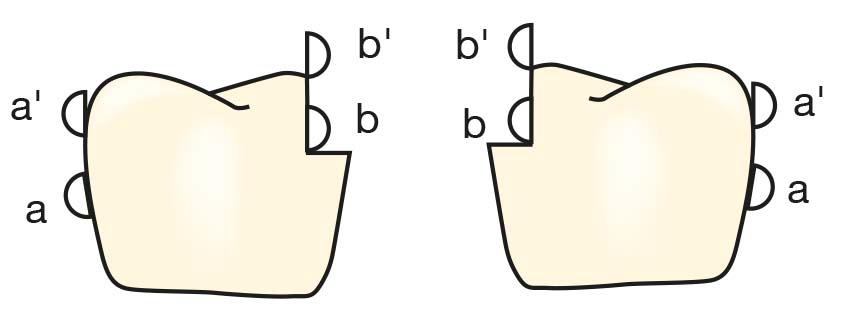
During the preparation of guide planes, it is important to distinguish between tooth-supported and distal extension prostheses. In tooth-supported cases, guide planes are prepared so that the stabilization arms of the clasp assemblies contact them during insertion and removal of the prosthesis, thereby reducing horizontal stresses on the teeth. In contrast, in distal extension cases, a flat guide plane prepared on the proximal surface adjacent to the denture base may increase stress on the abutment tooth due to the functional movement of the base. Therefore, the interface between the tooth and the clasp should be prepared to allow slight movement of the distal extension denture base without applying torque to the abutment tooth. The distal surface of the abutment tooth should be flattened sufficiently to reduce the amount of undercut between the minor connector and the tooth; however, the interface should not be prepared with perfect adaptation between the two surfaces as in tooth-supported cases.