
Chapter 7. Surveying
The most important factor in ensuring the success of a removable partial denture is the detailed and conscious planning of the prosthetic components. A significant part of the treatment planning process is the surveying of the model.
The prosthesis is securely placed on the teeth and edentulous ridges by examining the areas that will act as supporting structures. This prevents the prosthesis from moving while it is in place. Through a conscious analysis of the models, it becomes possible to plan a prosthesis that can be easily inserted and removed by the patient, contributes the most to the patient’s aesthetics, resists forces as much as possible, and does not cause food accumulation, as well as to define structures that need mouth preparation.
Components of Ney dental surveyor
Model analysis is best and most accurately performed using a dental surveyor or model analyzer, also known as a paralleling instrument. The commercially first produced and most widely used dental surveyor is the Ney model analyzer, which was introduced in 1923 (Figure 7-1).
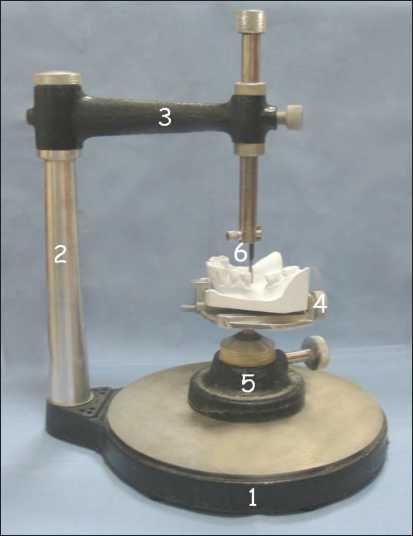
The Ney model analyzer generally includes the following components:
The “platform” on which the base can move,
The “vertical arm” that supports the entire structure,
The “horizontal arm” which is attached to the vertical arm and can rotate 360° around this arm, holding the measuring instruments,
The “table” to which the model is attached,
The “base” which allows the table to rotate on a free axis,
The instruments used in conjunction with the model analyzer, attached to the vertical arm:
Analyzer blade: It allows for the control of the parallelism between surfaces, the control of retentive areas, and the elimination of unwanted undercut areas on the model by filling them with wax after shaping the metal framework.
Carbon marker: Attached to the analyzer with metal support, it helps to define the equator line and draw the shape of an undercut area in soft tissue or ridge regions.
Undercut gauges: These instruments are used to determine the amount and position of the preferred retentive undercut on an abutment tooth surface. There are usually three options: 0.01 inch (0.25 mm), 0.02 inch (0.50 mm), and 0.03 inch (0.75 mm).
Phases of dental surveying
Two steps are involved in dental surveying:
I. Surveying the diagnostic cast: The best “path of insertion” is identified and choices on the kinds of oral preparations required are made.
II. Surveying the master cast: Soft tissue undercuts are identified, block-out and relief procedures are performed, and undercuts on abutment teeth are measured and marked in accordance with the survey line.